How Many Words Is 6,000 Characters?
By Raviraj Bhosale · Updated September 2, 2026 · 8 min read
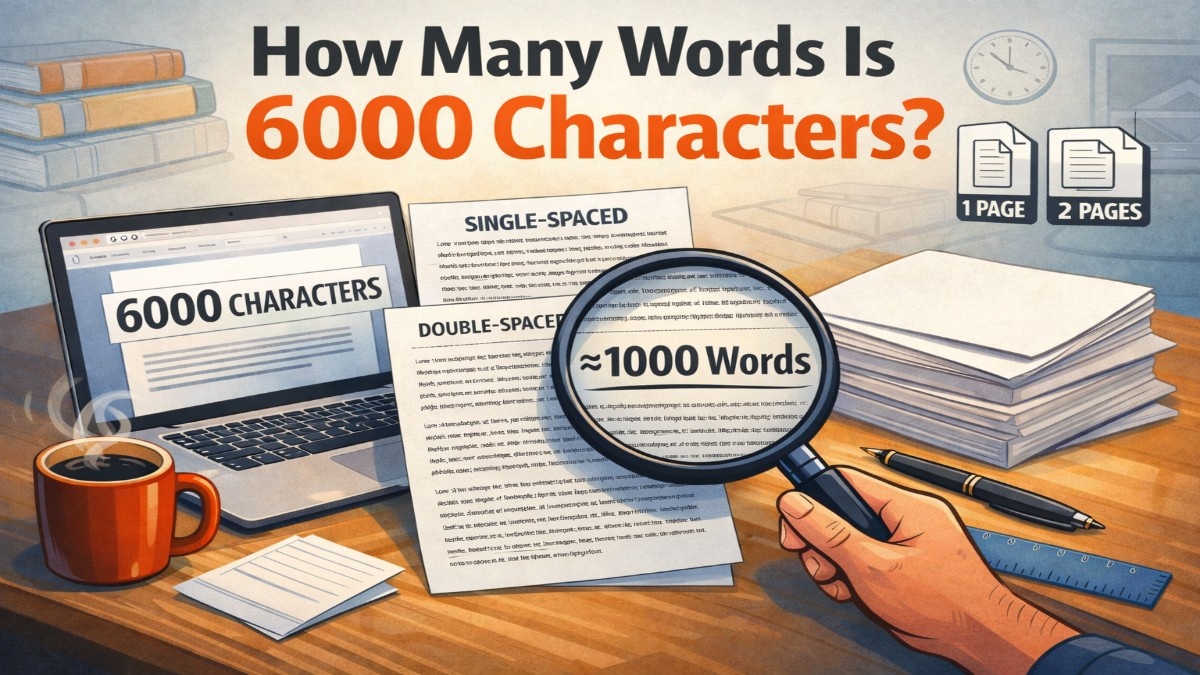
6,000 characters is roughly 900–1,000 words when spaces are included.The exact word count changes with word length, punctuation, numbers, and formatting, so this is an estimate rather than a fixed conversion.
If you are checking a writing limit, planning an article, or comparing a character limit with a word limit, the most useful way to think about 6,000 characters is as a roughly 1,000-word piece of writing.
📌 Quick Answer
- 6,000 characters with spaces: about 900–1,000 words
- 6,000 characters without spaces: often around 1,050–1,200 words
- 6,000 characters in pages: roughly 3–4 double-spaced pages in a common academic format
- Best practical estimate: treat 6,000 characters as approximately 1,000 words
How Many Words Are 6,000 Characters?
For most everyday English writing, 6,000 characters is about 900–1,000 words with spaces included. A document made mostly of short words can contain more words, while technical, academic, or legal writing can contain fewer.
6,000 Characters Including Spaces
When a tool counts spaces as characters, 6,000 characters usually works out to around 900–1,000 words. This is the estimate to use when a form, editor, or writing brief gives you a character limit and does not specify otherwise.
6,000 Characters Without Spaces
Removing spaces changes the conversion because the same text contains fewer counted characters. As a practical estimate, 6,000 non-space characters can represent roughly 1,050–1,200 words, depending on the writing style.
Character-to-Word Conversion Table (Bookmark This)
Use this reference table for quick estimates across common character counts. All figures use the English average of 5–6 characters per word with spaces included. For an exact count on your actual text, paste it directly into the free word and character counter at WordCounter.vip — it calculates word count, character count (with and without spaces), reading time, and readability score in real time, with no login required.
| Characters | Words | Time |
|---|---|---|
| 85 | ~10–15 | ~5 sec |
| 350 | ~50–70 | ~20 sec |
| 500 | ~80–100 | ~30 sec |
| 600 | ~90–110 | ~30 sec |
| 700 | ~110–130 | ~40 sec |
| 750 | ~120–140 | ~45 sec |
| 800 | ~130–150 | ~45 sec |
| 900 | ~140–160 | ~50 sec |
| 1,000 | ~150–175 | ~1 min |
| 1,200 | ~180–210 | ~1 min |
| 1,250 | ~190–220 | ~1–1.5 min |
| 1,300 | ~200–230 | ~1–1.5 min |
| 1,600 | ~250–280 | ~1–2 min |
| 2,000 | ~300–350 | ~1.5 min |
| 2,048 | ~300–360 | ~2 min |
| 2,400 | ~380–420 | ~2 min |
| 2,600 | ~400–450 | ~2–3 min |
| 3,000 | ~450–525 | ~2–3 min |
| 3,200 | ~500–560 | ~3 min |
| 3,500 | ~550–620 | ~3 min |
| 3,600 | ~560–630 | ~3–4 min |
| 3,900 | ~600–680 | ~4 min |
| 4,000 | ~600–700 | ~3 min |
| 4,096 | ~650–720 | ~4 min |
| 5,000 | ~750–880 | ~3–4 min |
| 6,000 | ~900–1,050 | ~4–5 min ← you are here |
| 6,500 | ~1,000–1,120 | ~5 min |
| 7,000 | ~1,100–1,250 | ~5–6 min |
| 7,500 | ~1,150–1,300 | ~6 min |
| 8,000 | ~1,250–1,400 | ~6 min |
| 9,000 | ~1,400–1,600 | ~7 min |
| 9,600 | ~1,500–1,700 | ~7–8 min |
| 10,000 | ~1,500–1,750 | ~7–8 min |
| 15,000 | ~2,400–2,650 | ~10–12 min |
| 20,000 | ~3,200–3,600 | ~14–16 min |
| 30,000 | ~4,800–5,400 | ~20–25 min |
| 32,000 | ~5,000–5,800 | ~25 min |
| 50,000 | ~8,000–9,000 | ~40–45 min |
| 60,000 | ~9,500–10,800 | ~50–55 min |
| 70,000 | ~11,000–12,500 | ~60+ min |
| 100,000 | ~16,000–18,000 | ~80–90 min |
* Reading time: ~4–5 min (200–250 WPM average speed)
6,000 Characters to Words: What Changes the Result?
There is no universal one-to-one conversion between characters and words. The result depends on the text itself, which is why calculators and estimates normally show a range.
Word Length
Short words use fewer characters, so 6,000 characters can contain more words. Long or technical words use more characters, so the same character budget can contain fewer words.
Spaces and Punctuation
Spaces, commas, periods, quotation marks, numbers, and other symbols can all contribute to the character count. That is why two documents with the same number of words can have different character totals.
Writing Style
A conversational article with short sentences will usually fit more words into 6,000 characters than a technical explanation filled with longer terms and symbols.
How Many Pages Is 6,000 Characters?
Because 6,000 characters is roughly 900–1,000 words for typical English text, it can take about 3–4 double-spaced pages or around 1.5–2 single-spaced pages in a common 12-point document format. Your exact page count depends on font, margins, paragraph spacing, and line spacing.
6,000 Characters in Pages With Standard Formatting
For a typical academic layout, 6,000 characters is usually in the range of a short assignment or several pages of double-spaced text. Treat page count as an estimate, especially when the formatting rules are strict.
Why the Page Count Can Change
Font family, font size, margins, headings, and line spacing all change how much text fits on a page. If a submission has specific formatting rules, use those settings instead of relying on a generic pages-to-characters estimate.
What Does 6,000 Characters Look Like in Real Writing?
Character limits are easier to understand when you compare them with actual use cases. A 6,000-character limit is large enough for a focused article, detailed explanation, or short academic response.
For a Blog Post
Around 900–1,000 words gives you enough room for an introduction, several useful sections, examples, and a concise conclusion. The ideal length still depends on the topic and search intent rather than the character count alone.
For a College or University Assignment
A 6,000-character response can represent a substantial short assignment, but always follow the required word or character limit supplied by your institution.
For Forms, Applications, and Text Fields
Character limits are often stricter than word limits. Before submitting, check whether the field counts spaces, line breaks, or special characters so your estimate matches the actual limit.
How Many Characters Are in Other Word Counts?
The same conversion works in reverse. A word count can be translated into an approximate character count, but the result still depends on average word length and whether spaces are included.
Use the Conversion Range, Not a Single Exact Number
For planning purposes, a range is more useful than pretending that every word has the same number of characters. Use the conversion table above as a quick reference, then check the final text with a character counter when the limit is strict.
How to Stay Within a 6,000-Character Limit
Lead With the Main Answer
Put the most important information first. This reduces unnecessary introductory text and makes a fixed character budget easier to manage.
Remove Repetition
Look for repeated explanations, filler phrases, and sentences that add no new information. Cutting redundancy improves clarity while freeing characters for useful detail.
Check the Final Character Count
Estimates are useful for planning, but the final submission should be measured with the same tool or platform that enforces the limit whenever possible.
Frequently Asked Questions About 6,000 Characters
How many words is 6,000 characters?
6,000 characters is usually about 900–1,000 words with spaces included. The exact result depends on word length, punctuation, and formatting.
How many words are 6,000 characters including spaces?
A practical estimate is about 900–1,000 words when spaces are included in the character count.
How many words is 6,000 characters without spaces?
Without counting spaces, 6,000 characters can represent roughly 1,050–1,200 words, depending on the text.
How many pages is 6,000 characters?
For typical 12-point academic formatting, 6,000 characters is roughly 3–4 double-spaced pages, although fonts, margins, and spacing can change the result.
Is 6,000 characters a lot of writing?
It is a substantial amount for a short article, explanation, or assignment response. In practical terms, think of it as roughly a 1,000-word piece of writing.
How long is 6,000 characters?
In typical English prose, 6,000 characters is approximately 900–1,000 words. Reading time depends on the reader and the complexity of the text, so word count is a better planning measure than character count alone.
Can 6,000 characters be exactly 1,000 words?
Yes, it can happen, but there is no fixed rule that makes 6,000 characters equal exactly 1,000 words. Different words and punctuation produce different character totals.
How many paragraphs is 6,000 characters?
The number depends on paragraph length and writing style. If paragraphs are kept short for web readability, 6,000 characters may be spread across more paragraphs than a traditionally formatted essay.
What is the best way to check 6,000 characters?
Use a character counter on the final text and verify whether the counter includes spaces. This gives a more reliable result than estimating from word count alone.
Final Answer: 6,000 Characters in Words
6,000 characters is approximately 900–1,000 words with spaces included.Without spaces, the same character count can represent roughly 1,050–1,200 words. Use the conversion table above for a quick estimate and a character counter for the exact final count.
BLOG
How Many Words Per Page
by Raviraj Bhosale
Discover how many words fit on a page. Learn word counts for double spaced, single spaced, and handwritten pages with real examples.
BLOG
How Many Words Fit on an A4 Page
by Raviraj Bhosale
An A4 page typically holds 400 to 500 words using standard formatting (12pt font, 1-inch margins, single spacing). For academic or double-spaced documents, this drops to roughly 250 words.
BLOG
How Many Words Per Page: Times New Roman 12, 1.5 Spacing
by Raviraj Bhosale
A document using Times New Roman 12pt font with 1.5 spacing typically contains approximately 375 to 450 words per page, assuming standard 1-inch margins on A4 or US Letter paper.