How Many Words Is 100000 Characters?
By Raviraj Bhosale · Updated April 19, 2026 · 12 min read
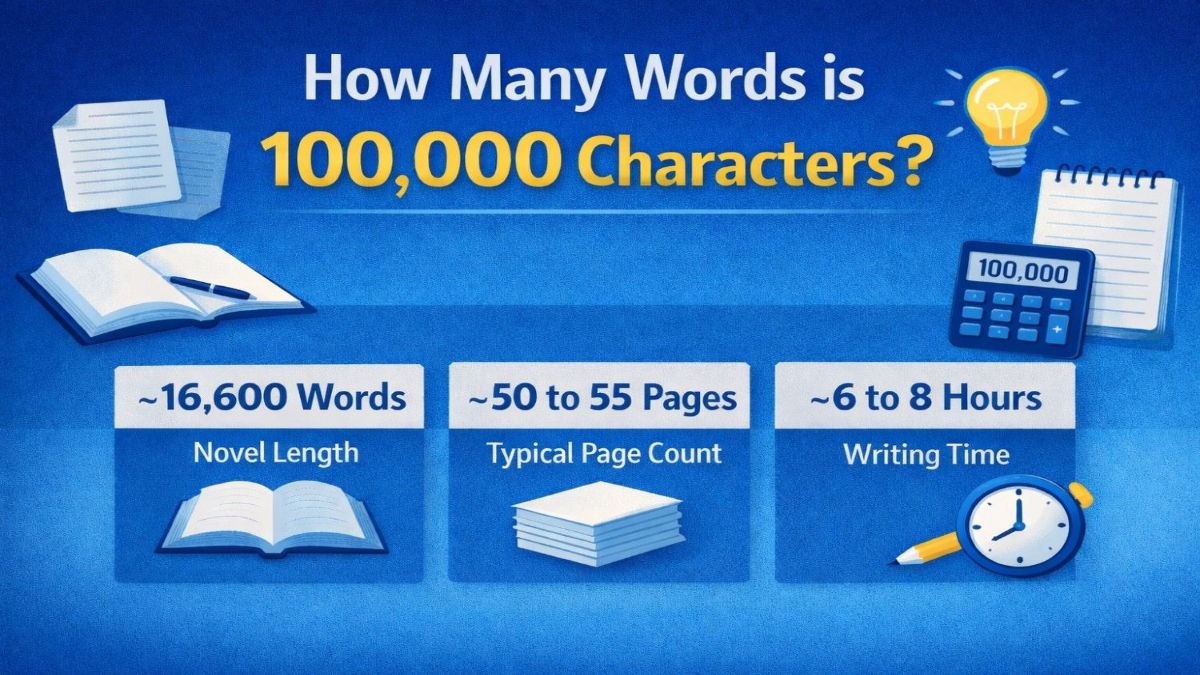
Short answer: 100,000 characters equals approximately 17,500 to 21,000 words — roughly 17,500 words when spaces are included (the default on every major writing platform) and around 21,000 words when spaces are stripped out. At that length, you are looking at a full short novella, a master's thesis, or a comprehensive long-form research report. This is serious, book-length territory — not a quick blog post.
Whether you are a novelist tracking manuscript length, a developer sizing a database TEXT field, a student facing a university word-count requirement, or a content strategist planning a pillar page — knowing exactly what 100,000 characters translates to in real words changes how you plan, draft, and edit. This guide covers the core math, a reference conversion table, real-world contexts where this character volume appears, and practical tips for handling documents at this scale.
📊 Quick Reference: 100,000 Characters at a Glance
- 100,000 characters with spaces: ~17,500–17,550 words
- 100,000 characters without spaces: ~21,000–21,300 words
- Estimated reading time: ~70–88 minutes (at 200–250 wpm)
- Estimated writing time: ~12–20 hours of focused drafting (at ~500–800 words/hour)
- Equivalent page length: ~35–40 double-spaced A4 pages (12pt Times New Roman, 1-inch margins)
- Single-spaced A4 equivalent: ~18–20 pages
- Common real-world equivalents: Short novella, master's thesis, in-depth industry white paper, comprehensive e-book, long-form academic dissertation chapter
Why Do Characters and Words Produce Different Numbers?
Characters and words measure completely different things. A character is any single unit of text — a letter, digit, space, comma, apostrophe, or even an emoji. A word is a cluster of non-space characters surrounded by whitespace. The gap between the two creates the conversion challenge.
The Oxford English Dictionary's corpus analysis places the average English word length at 4.7 characters. Add one trailing space and that rises to 5.7 characters per word. Divide 100,000 by 5.7 and you get approximately 17,544 words. Divide 100,000 by 4.7 and you get approximately 21,276 words. That spread — roughly 3,700 words — exists because of natural variation in vocabulary, punctuation density, and style.
Here is the exact formula this article uses for every estimate:
Words ≈ Characters (with spaces) ÷ 5.7
Words ≈ Characters (without spaces) ÷ 4.7
Example: 100,000 ÷ 5.7 ≈ 17,544 words | 100,000 ÷ 4.7 ≈ 21,276 words
You see a range rather than a fixed number because English word length varies considerably by context. Legal contracts and academic dissertations lean heavily on polysyllabic vocabulary — words like "substantiation," "epistemological," or "aforementioned." Casual journalistic prose and marketing copy favour short, punchy words like "get," "fix," "try," and "now." The same 100,000 characters can produce word totals that differ by 2,000 or more depending entirely on your writing style.
Does Writing Style Affect How Many Words Fit in 100,000 Characters?
Significantly, yes. The same 100,000-character budget can yield anywhere from around 14,000 words in dense legal or technical prose to approximately 22,000 words in fast-paced, conversational copy. That 8,000-word gap is equivalent to a full short story — it matters enormously when you are planning a manuscript or sizing a database field.
Academic and legal writing uses multi-syllable vocabulary extensively. Words like "telecommunications," "pharmaceutical," and "interdisciplinary" each consume 17–18 characters alone — so long-word-heavy writing will push your character count up fast while keeping word totals low.
Casual, conversational writing relies on high-frequency short words. Think of the vocabulary in a lifestyle blog or a product how-to guide. Short words pack far more per 100,000 characters without sacrificing meaning.
Punctuation load also matters. Em dashes, ellipses, quotation marks, parentheses, and semicolons all eat character slots without contributing to word count. A punctuation-heavy text hits 100,000 characters faster than clean, declarative prose would.
Character-to-Word Conversion Table (Bookmark This)
Use this reference table for quick estimates across common character counts. All figures use the English average of 5–6 characters per word with spaces included. For an exact count on your actual text, paste it directly into the free word and character counter at WordCounter.vip — it calculates word count, character count (with and without spaces), reading time, and readability score in real time, with no login required.
| Characters | Words | Time |
|---|---|---|
| 85 | ~10–15 | ~5 sec |
| 350 | ~50–70 | ~20 sec |
| 500 | ~80–100 | ~30 sec |
| 600 | ~90–110 | ~30 sec |
| 700 | ~110–130 | ~40 sec |
| 750 | ~120–140 | ~45 sec |
| 800 | ~130–150 | ~45 sec |
| 900 | ~140–160 | ~50 sec |
| 1,000 | ~150–175 | ~1 min |
| 1,200 | ~180–210 | ~1 min |
| 1,250 | ~190–220 | ~1–1.5 min |
| 1,300 | ~200–230 | ~1–1.5 min |
| 1,600 | ~250–280 | ~1–2 min |
| 2,000 | ~300–350 | ~1.5 min |
| 2,048 | ~300–360 | ~2 min |
| 2,400 | ~380–420 | ~2 min |
| 2,600 | ~400–450 | ~2–3 min |
| 3,000 | ~450–525 | ~2–3 min |
| 3,200 | ~500–560 | ~3 min |
| 3,500 | ~550–620 | ~3 min |
| 3,600 | ~560–630 | ~3–4 min |
| 3,900 | ~600–680 | ~4 min |
| 4,000 | ~600–700 | ~3 min |
| 4,096 | ~650–720 | ~4 min |
| 5,000 | ~750–880 | ~3–4 min |
| 6,000 | ~900–1,050 | ~4–5 min |
| 6,500 | ~1,000–1,120 | ~5 min |
| 7,000 | ~1,100–1,250 | ~5–6 min |
| 7,500 | ~1,150–1,300 | ~6 min |
| 8,000 | ~1,250–1,400 | ~6 min |
| 9,000 | ~1,400–1,600 | ~7 min |
| 9,600 | ~1,500–1,700 | ~7–8 min |
| 10,000 | ~1,500–1,750 | ~7–8 min |
| 15,000 | ~2,400–2,650 | ~10–12 min |
| 20,000 | ~3,200–3,600 | ~14–16 min |
| 30,000 | ~4,800–5,400 | ~20–25 min |
| 32,000 | ~5,000–5,800 | ~25 min |
| 50,000 | ~8,000–9,000 | ~40–45 min |
| 60,000 | ~9,500–10,800 | ~50–55 min |
| 70,000 | ~11,000–12,500 | ~60+ min |
| 100,000 | ~16,000–18,000 | ~80–90 min ← you are here |
* Reading time: ~80–90 min (200–250 WPM average speed)
How Many Pages Is 100,000 Characters?
At roughly 17,500 words, 100,000 characters fills approximately 35–40 double-spaced A4 pages in Times New Roman 12pt with standard 1-inch margins. In single-spaced format, that same text occupies around 18–20 pages.
For context: a standard A4 double-spaced page holds approximately 250–275 words (roughly 1,425–1,567 characters). Divide 100,000 characters by 1,425 and you arrive at 70 single-spaced pages; by 2,850 (double-spaced) and you get ~35 pages. Your font choice shifts this slightly — Times New Roman is more condensed than Arial or Calibri, fitting roughly 10% more characters per line.
📄 Page Count Estimates for 100,000 Characters
- 📖 Double-spaced A4 (12pt Times New Roman): ~35–40 pages
- 📃 Single-spaced A4 (12pt Times New Roman): ~18–20 pages
- 📋 Double-spaced US Letter (12pt Calibri): ~38–44 pages
- 📑 Single-spaced US Letter (12pt Calibri): ~19–22 pages
- 📚 Paperback novel pages (10–11pt, ~300 words/page): ~58–62 pages
💡 Need an exact page count for your format?
The words-per-page calculator at WordCounter.vip lets you set your font, point size, line spacing, page dimensions, and margins to generate a precise, tailored estimate. It supports APA, MLA, Chicago, A4, US Letter, and custom formats.
What Real-World Documents Are About 100,000 Characters Long?
100,000 characters is not a casual content format — it represents a serious, long-form body of work. Here is exactly where this character volume appears across professional, academic, and creative contexts.
Academic Writing
A typical master's thesis in the humanities or social sciences runs 15,000–25,000 words — squarely within the 85,500–142,500 character range. Many UK universities, including the University of Oxford and the London School of Economics, publish official thesis guidelines specifying word counts in this range. A 100,000-character submission sits comfortably at the centre of that band.
For doctoral dissertations, 100,000 characters represents approximately one major chapter. The Economic and Social Research Council (ESRC) notes that a full PhD dissertation typically runs 80,000–100,000 words — meaning 100,000 characters is roughly one-fifth of a complete doctoral thesis.
Creative and Fiction Writing
The Science Fiction and Fantasy Writers Association (SFWA) classifies a "novelette" as 7,500–17,500 words, and a "novella" as 17,500–40,000 words. At ~17,500 words, 100,000 characters sits precisely at the novelette-to-novella boundary — a complete, publishable work of short fiction by industry standards.
Notable published novellas in this range include George Orwell's Animal Farm (~30,000 words) and F. Scott Fitzgerald's The Great Gatsby (~47,094 words). At 17,500 words, 100,000 characters is roughly half the length of Fitzgerald's novel — a tight, complete narrative arc in the right hands.
Professional and Business Writing
In the corporate world, comprehensive industry white papers typically run 5,000–10,000 words. A 100,000-character document at ~17,500 words represents a full-length research report, an in-depth feasibility study, or a complete e-book — the kind of high-value gated content that SaaS companies and management consultancies use as lead magnets.
McKinsey Global Institute reports, Gartner Research Notes, and Forrester Wave evaluations typically run in the 10,000–25,000-word range — exactly the territory 100,000 characters occupies. If you are drafting at this length, you are working at the same scale as some of the most commercially valuable business content in the world.
Developer and API Contexts
In software engineering, 100,000 characters frequently appears as a limit on TEXT or LONGTEXT column definitions in MySQL, PostgreSQL, and Microsoft SQL Server. These fields are used for storing rich user-generated content — forum posts, legal agreements, multi-chapter documentation, and full product manuals.
For AI and LLM contexts: 100,000 characters equals approximately 25,000 tokens using the standard GPT-4 tokenizer (roughly 4 characters per token). Claude 3 Sonnet's 200,000-token context window can comfortably hold approximately 800,000 characters — meaning 100,000 characters is just one-eighth of a single Claude conversation context.
How Does 100,000 Characters Compare to Other Common Lengths?
Numbers make more sense with familiar benchmarks. Here is where 100,000 characters sits in the landscape of content lengths that writers, developers, and marketers encounter regularly:
- 📩 SMS message (single): 160 characters (~28 words)
- 🐦 Twitter / X post: 280 characters (~49 words)
- 📝 Instagram caption (full limit): 2,200 characters (~386 words)
- 📄 Minimum SEO blog post: ~6,000 characters (~1,050 words)
- 📰 Long-form article or pillar page: ~20,000–30,000 characters (~3,500–5,260 words)
- 📗 Short e-book / white paper: ~30,000–50,000 characters (~5,265–8,770 words)
- 🟢 100,000 characters: ~17,500 words — novelette / master's thesis chapter
- 📚 Full novel (average): ~450,000–540,000 characters (~80,000–95,000 words)
- 📖 Harry Potter and the Philosopher's Stone: ~446,000 characters (~77,325 words)
By comparison, 100,000 characters is more than 357 times a single tweet, roughly 45 times a full Instagram caption, and about one-fifth of an average literary novel. It is the scale where individual articles end and books begin.
Is 100,000 Characters Good for SEO Content?
At ~17,500 words, a 100,000-character document is far beyond the typical blog post — but this scale represents a powerful SEO asset if structured correctly. It is the territory of "ultimate guides," comprehensive resource hubs, and topic-authority pillars.
HubSpot's 2024 State of Marketing Report found that long-form content (2,500+ words) generates approximately 3× more backlinksthan average-length posts. At 17,500 words, a well-structured piece at this scale can realistically target dozens of related long-tail keywords within a single URL — a strategy Google explicitly recognises through its Helpful Content guidance, which rewards "depth, original insight, and comprehensiveness" over thin-but-frequent publishing.
That said, quality controls at this length are critical. Google's Search Quality Evaluator Guidelines (March 2024 update) specifically penalise content that is long for length's sake — repetitive paragraphs, padded sections, and information republished without added insight all reduce E-E-A-T signals. Every section of a 17,500-word document must earn its place.
📌 SEO tip: Before publishing long-form content, run your final URL through the website word count tool at WordCounter.vip to audit final word depth and character count without any copy-paste or browser extension needed.
How Long Does It Take to Write 100,000 Characters?
At roughly 17,500 words, this is a significant writing project. Here is a realistic breakdown of drafting time based on published productivity data from professional writers:
- ✍️ Slow, careful drafter (300–400 wph): 44–58 hours of pure writing time
- 🖊️ Average professional writer (500–700 wph): 25–35 hours
- ⚡ Fast touch-typist / experienced journalist (800–1,000 wph): 17–22 hours
- 🔍 Research time (typical non-fiction): Add 50–100% on top of drafting
- ✅ Editing and proofreading (professional standard): Add 30–50% on top of drafting
NaNoWriMo (National Novel Writing Month) sets its 30-day challenge at 50,000 words — nearly 3× the size of a 100,000-character document. Participants who complete NaNoWriMo write approximately 1,667 words per day. At that pace, 17,500 words takes about 10–11 days of sustained daily writing.
7 Practical Tips for Managing a 100,000-Character Document
Writing at this scale is a project management problem as much as a writing one. Here is how professionals approach long-form work without losing coherence or running out of steam halfway through.
- Outline first, write second. At 17,500 words, an unplanned document quickly becomes incoherent. Professional non-fiction editors at publishers like Penguin Random House recommend spending at least 10–15% of your total project time on structural planning before writing a single body paragraph.
- Break it into 1,000-character (roughly 175-word) chunks.Facing 100,000 characters at once is psychologically paralyzing. Divide it into 100 discrete sections of ~175 words each. Each chunk becomes a standalone micro-task — achievable in 15–20 minutes.
- Track character count, not just word count. Microsoft Word, Google Docs, and most CMSs show word count by default. For character-limited fields — database columns, API inputs, publication submission portals — always switch your tracking to characters explicitly, as they count differently.
- Use headers as chapter contracts. In a 17,500-word piece, every H2 heading is a promise to the reader. Write your full heading list before filling in the prose — this reveals structural gaps, redundancies, and logical flow problems before you spend hours drafting sections you will later delete.
- Audit every section for unique insight. Google's Helpful Content system rewards sections that add original value not found elsewhere. For each section in a 100,000-character document, ask: does this section contain information the reader cannot find by searching this topic directly? If the answer is no, rewrite or cut.
- Edit in passes, not in one sweep. Professional book editors at major houses use separate editing passes: one for structural logic, one for sentence-level clarity, one for fact-checking, and one for style consistency. Trying to catch everything in a single read-through fails at 1,500 words; at 17,500, it is virtually impossible.
- Use a character counter tool before final submission.Many submission portals, API endpoints, and CMS fields count characters differently — with or without HTML tags, with or without whitespace normalisation. Always verify your final character count using the WordCounter.vip character counter to avoid surprises at submission.
Frequently Asked Questions
Is 100,000 characters a lot of text?
Yes — by any standard. 100,000 characters (~17,500 words) is longer than most academic essays, longer than the majority of published white papers, and longer than many published novelettes. For a single web page, it is extremely long. For a book, it is a substantial chapter or short novella. Context determines whether "a lot" is appropriate — for a Wikipedia article on a major topic or an industry pillar guide, this length can be justified; for a product page or FAQ, it would be overwhelming.
How long does it take to read 100,000 characters?
At the typical adult silent reading pace of 200–250 words per minute, ~17,500 words takes between 70 and 88 minutes to read from start to finish. At the average speed-reading pace of 400–500 wpm, the same text takes around 35–44 minutes. For academic reading with active annotation, allow 2.5–3.5 hours.
Do spaces count in a 100,000-character limit?
On virtually all major platforms — Microsoft Word, Google Docs, Instagram, LinkedIn, and most database VARCHAR/TEXT field implementations — spaces count as characters by default. Always verify a specific platform's documentation if your limit is strictly enforced. The with-spaces vs. without-spaces distinction can shift your total word count by more than 3,700 words at the 100,000-character scale.
How many paragraphs is 100,000 characters?
A standard paragraph typically runs 100–150 words, or roughly 570–855 characters. That makes 100,000 characters approximately 117 to 175 paragraphs. In web writing — where shorter 2–3 sentence paragraphs are preferred for mobile readability — 100,000 characters can span 200 or more visually distinct blocks.
How many sentences is 100,000 characters?
An average English sentence runs 15–20 words, or roughly 90–115 characters including punctuation and spacing. At that rate, 100,000 characters contains approximately 870 to 1,110 sentences. A conversational style with short punchy sentences will land near the top of that range; complex academic sentence structures will land near the bottom.
How many tokens is 100,000 characters for AI models?
Using OpenAI's tiktoken tokenizer (which uses roughly 4 characters per token for English text), 100,000 characters equals approximately 25,000 tokens. For Anthropic's Claude models, the tokenization is similar. Most LLMs with 128,000-token context windows can process 100,000 characters comfortably within a single context. Claude 3's 200,000-token context window can fit approximately 800,000 characters — eight times a 100,000-character document — in a single conversation.
How many characters are in an average English word?
According to Oxford English Dictionary corpus analysis, the average English word is 4.7 characters long, excluding the trailing space. With one space included, it rises to 5.7 characters per word. This ratio underpins every character-to-word estimate used by writing tools, readability calculators, and content planning guides worldwide — including all estimates in this article.
Final Answer: How Many Words Is 100,000 Characters?
The direct, verified answer: 100,000 characters equals approximately 17,500 words when spaces are counted, or roughly 21,000–21,300 words if spaces are excluded. The estimate is grounded in the Oxford English Dictionary corpus average of 4.7 characters per English word — rising to 5.7 characters when the trailing space is included.
For practical planning — sizing a database field, estimating manuscript length, calculating AI token usage, or planning a long-form SEO pillar page — treating 100,000 characters as approximately 17,500 words is accurate and reliable across virtually all English writing contexts.
One thing worth keeping in mind at this scale: character count is a measurement, not a goal. A tightly structured, insight-dense 17,500-word document will always outperform a padded, repetitive 17,500-word document — in reader engagement, in SEO performance, and in real-world usefulness. Write with purpose, track your count, and let the length follow the quality.
BLOG
How Many Words Is 900 Characters?
by Raviraj Bhosale
900 characters equals approximately 130–160 words with spaces. Learn accurate word count conversions, real-world platform limits, and practical writing tips.
BLOG
How Many Words Is 1250 Characters?
by Raviraj Bhosale
1250 characters equals approximately 180–220 words with spaces. Learn exact word count conversions, real-world platform examples, and practical writing tips.
BLOG
How Many Words Is 600 Characters?
by Raviraj Bhosale
600 characters equals approximately 100–120 words with spaces. Learn accurate word count conversions, platform examples, and practical writing tips.