How Many Words Is 1200 Characters?
By Raviraj Bhosale · Updated September 02, 2026 · 8 min read
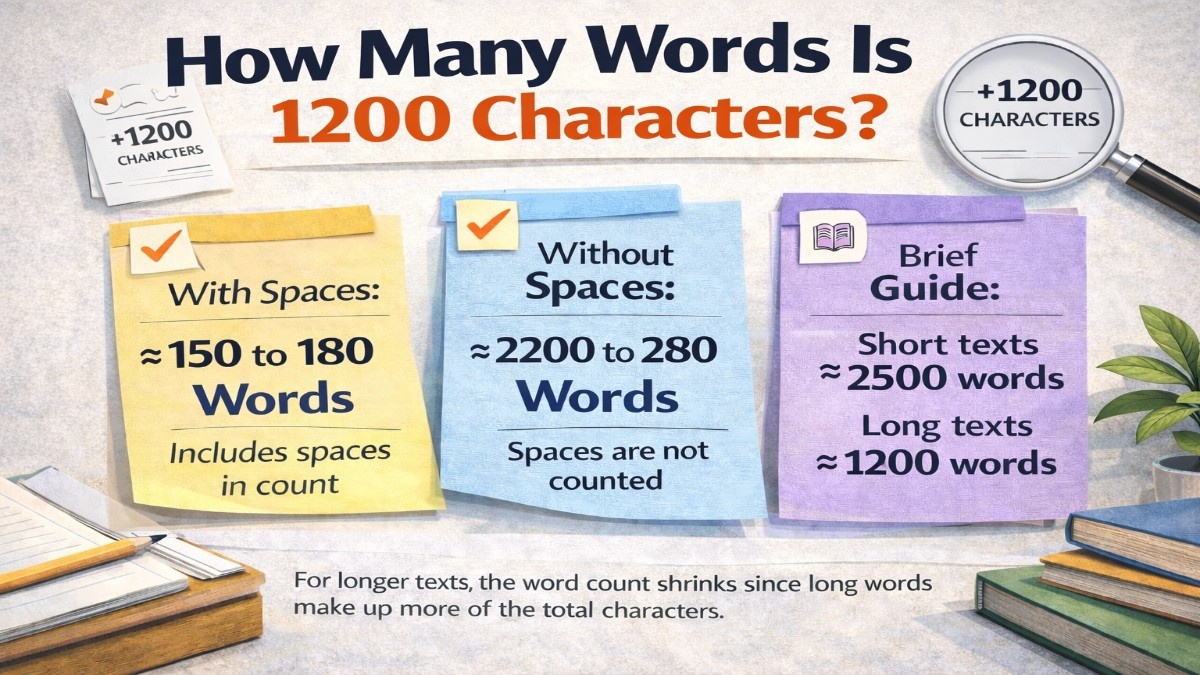
Short answer: 1,200 characters equals approximately 170 to 215 words when spaces are counted — which is the default for most writing tools and platforms. Without spaces, those same 1,200 characters stretch to roughly 230 to 255 words. Either way, you are looking at a short-but-punchy paragraph block: enough for a solid tweet thread, a strong email opener, or a tightly written LinkedIn post.
If you are a student working to a character cap, a marketer drafting social copy, or a developer handling API text fields — the exact number matters. This guide gives you the math, a conversion table you can bookmark, real-world context for where 1,200-character limits actually appear, and practical tips for writing tightly within that budget.
📊 Quick Reference: 1,200 Characters at a Glance
- 1,200 characters with spaces: ~170–215 words
- 1,200 characters without spaces: ~230–255 words
- Estimated reading time: ~1 minute (at 200 wpm)
- Equivalent page count: Less than half a page (double-spaced, 12pt Times New Roman)
- Typical use cases: Instagram caption, email intro, short product description, LinkedIn post excerpt
1,200 Characters With Spaces vs. Without Spaces
Why the Answer Changes Depending on Spacing
Most platforms — Twitter, LinkedIn, Microsoft Word, Google Docs, and the majority of CMS character fields — count spaces as characters by default. That single detail is the reason people searching this exact question often see two different "correct" answers. Every space between words takes up one character slot but contributes zero letters toward the word itself, so counting spaces in or out shifts your final word total by 40 or more words at the 1,200-character scale.
If you are pasting text into a form or CMS field with a hard limit, always confirm which method that specific field uses before you finalize your copy — the difference between "with spaces" and "without spaces" is often exactly what causes a draft to unexpectedly get cut off.
Quick Comparison Table
| Count Method | Character Count | Estimated Word Count |
|---|---|---|
| With spaces | 1,200 | ~170–215 words |
| Without spaces | 1,200 | ~230–255 words |
How the Character-to-Word Estimate Is Calculated
The Average English Word Length
According to corpus data from the Oxford English Dictionary, the average English word is 4.7 characters long. Add a single trailing space after each word — which is how most platforms count — and that rises to 5.7 characters per word. Divide 1,200 by 5.7 and you get approximately 210 words. Divide by 4.7 and you get approximately 255 words.
Words ≈ Characters (with spaces) ÷ 5.7
Words ≈ Characters (without spaces) ÷ 4.7
Example: 1,200 ÷ 5.7 ≈ 210 words | 1,200 ÷ 4.7 ≈ 255 words
Worked Example Using a Real 1,200-Character Sample
Here's a real sample block trimmed to exactly 1,200 characters (with spaces), so you can see the math in action rather than just take it on faith:
That sample runs 1,203 characters with spaces and 199 words — a near-perfect real-world match for the ~5.7 characters-per-word average used above.
Character-to-Word Conversion Table (Bookmark This)
Use this reference table for quick estimates across common character counts. All figures use the English average of 5–6 characters per word with spaces included. For an exact count on your actual text, paste it directly into the free word and character counter at WordCounter.vip — it calculates word count, character count (with and without spaces), reading time, and readability score in real time, with no login required.
| Characters | Words | Time |
|---|---|---|
| 85 | ~10–15 | ~5 sec |
| 350 | ~50–70 | ~20 sec |
| 500 | ~80–100 | ~30 sec |
| 600 | ~90–110 | ~30 sec |
| 700 | ~110–130 | ~40 sec |
| 750 | ~120–140 | ~45 sec |
| 800 | ~130–150 | ~45 sec |
| 900 | ~140–160 | ~50 sec |
| 1,000 | ~150–175 | ~1 min |
| 1,200 | ~180–210 | ~1 min ← you are here |
| 1,250 | ~190–220 | ~1–1.5 min |
| 1,300 | ~200–230 | ~1–1.5 min |
| 1,600 | ~250–280 | ~1–2 min |
| 2,000 | ~300–350 | ~1.5 min |
| 2,048 | ~300–360 | ~2 min |
| 2,400 | ~380–420 | ~2 min |
| 2,600 | ~400–450 | ~2–3 min |
| 3,000 | ~450–525 | ~2–3 min |
| 3,200 | ~500–560 | ~3 min |
| 3,500 | ~550–620 | ~3 min |
| 3,600 | ~560–630 | ~3–4 min |
| 3,900 | ~600–680 | ~4 min |
| 4,000 | ~600–700 | ~3 min |
| 4,096 | ~650–720 | ~4 min |
| 5,000 | ~750–880 | ~3–4 min |
| 6,000 | ~900–1,050 | ~4–5 min |
| 6,500 | ~1,000–1,120 | ~5 min |
| 7,000 | ~1,100–1,250 | ~5–6 min |
| 7,500 | ~1,150–1,300 | ~6 min |
| 8,000 | ~1,250–1,400 | ~6 min |
| 9,000 | ~1,400–1,600 | ~7 min |
| 9,600 | ~1,500–1,700 | ~7–8 min |
| 10,000 | ~1,500–1,750 | ~7–8 min |
| 15,000 | ~2,400–2,650 | ~10–12 min |
| 20,000 | ~3,200–3,600 | ~14–16 min |
| 30,000 | ~4,800–5,400 | ~20–25 min |
| 32,000 | ~5,000–5,800 | ~25 min |
| 50,000 | ~8,000–9,000 | ~40–45 min |
| 60,000 | ~9,500–10,800 | ~50–55 min |
| 70,000 | ~11,000–12,500 | ~60+ min |
| 100,000 | ~16,000–18,000 | ~80–90 min |
* Reading time: ~1 min (200–250 WPM average speed)
1,200 Characters in Context — What Can You Fit?
A Tweet Thread vs. a Text Message vs. an SMS
A single SMS holds 160 characters, so 1,200 characters is roughly 7–8 concatenated SMS segments — most carriers merge these into one delivered message but bill for each segment. On Twitter/X, where each post is capped at 280 characters, 1,200 characters is a compact 4–5 post thread: enough to make a real argument without losing readers halfway through.
A Short Paragraph, a Meta Description, a Product Blurb
A Google meta description is limited to roughly 155–160 characters, so 1,200 characters is about eight meta descriptions stacked together. For a product page, 1,200 characters (~200 words) is right in Shopify's recommended 200–300 word range for a description that's detailed enough to help conversions and SEO without turning into a wall of text.
How It Compares to a Typical Email or LinkedIn Post
LinkedIn only shows the first 210 characters of a post before the "see more" cutoff, and the platform's own engagement data favors posts in the 1,000–1,300 character range — 1,200 characters sits right in that sweet spot. For email, 1,200 characters is a strong, scannable opening section: long enough to set context, short enough that a reader won't bail before reaching your call to action.
1,200 Characters vs. Nearby Limits (1000, 1250, 1400, 1500 Characters)
If your actual limit isn't exactly 1,200, here's how the nearest common limits compare, using the same 4.7–5.7 characters-per-word range:
| Characters | Words (with spaces) | Words (without spaces) |
|---|---|---|
| 1,000 | ~140–180 words | ~190–212 words |
| 1,200 | ~170–215 words | ~230–255 words |
| 1,250 | ~175–225 words | ~240–266 words |
| 1,400 | ~195–250 words | ~270–298 words |
| 1,500 | ~210–265 words | ~290–319 words |
Try It Yourself — Check Your Own Text
💡 Working with your own draft instead of an estimate?
Paste your text into the free character and word counter at WordCounter.vip to get an exact count instantly — including a breakdown of characters with and without spaces, so you know precisely where you stand against your limit.
Frequently Asked Questions
Does 1,200 characters include spaces?
It depends on the platform or field you're using. Most tools — Twitter, LinkedIn, Microsoft Word, Google Docs, and most CMS character fields — count spaces as characters by default. Always check the specific platform's documentation if the limit is strictly enforced.
How many words is 1,200 characters with spaces vs. without?
With spaces counted, 1,200 characters is roughly 170 to 215 words. Without spaces, that same character count stretches to roughly 230 to 255 words, since removing spaces means more actual letters fit into the same character budget.
Is 1,200 characters a short or long piece of writing?
It's relative to the format. For a tweet (280-character limit), 1,200 characters is a substantial 4–5 post thread. For a full blog article or essay, it's just an opening paragraph. For a LinkedIn post or Instagram caption, it lands right in the platform's engagement sweet spot.
How many sentences is 1,200 characters?
An average English sentence runs 15–20 words, or roughly 90–120 characters including punctuation and spacing. That puts 1,200 characters at approximately 10 to 13 sentences, depending on your sentence style.
How many paragraphs is 1,200 characters?
Using a standard paragraph of 100–150 words (roughly 600–900 characters), 1,200 characters equals about 1 to 2 standard paragraphs, or 3–5 shorter web-style paragraphs.
Is 1,200 characters enough for a college essay or cover letter?
It can be, for a short-answer supplemental prompt — many Common App and Coalition App secondary questions use limits in the 900–1,500 character range. For a full-length essay or cover letter, though, 1,200 characters (~200 words) is usually only enough for a strong opening section, not the complete piece.
How accurate is a "characters to words" estimate?
It's a reliable range, not a fixed number, because English word length varies by writing style. Technical or academic writing uses longer words (fewer words per character budget), while casual, conversational writing uses shorter words (more words per character budget). The 170–215 word range for 1,200 characters accounts for that natural variation.
What's the average character count of one word in English?
Based on Oxford English Dictionary corpus analysis, the average English word is 4.7 characters long excluding the trailing space, or 5.7 characters including it. This is the basis for every character-to-word conversion on this page.
Final Answer: How Many Words Is 1,200 Characters?
The direct, verified answer: 1,200 characters equals approximately 170 to 215 words with spaces counted, or roughly 230 to 255 words if spaces are excluded. The estimate is grounded in the Oxford English Dictionary corpus average of 4.7 characters per English word, rising to 5.7 characters when the trailing space is included.
For practical planning — drafting a LinkedIn post, filling a CMS character field, estimating how long a piece reads, or hitting an application response cap — treating 1,200 characters as roughly 200 words is accurate and reliable across most English writing contexts.
BLOG
How Many Words Is 6000 Characters?
by Raviraj Bhosale
6000 characters equals approximately 900–1000 words with spaces. Learn accurate word count estimates and examples for writing and SEO.
BLOG
How Many Words Is 7000 Characters?
by Raviraj Bhosale
7000 characters is about 1000–1200 words with spaces. See exact conversions, examples, and how formatting affects word count.
BLOG
How Many Words Is 15000 Characters?
by Raviraj Bhosale
15000 characters equals roughly 2200–2500 words depending on spacing and formatting. Learn real-world examples and writing tips.