How Many Words Is 1250 Characters?
By Raviraj Bhosale · Updated April 17, 2026 · 8 min read
Short answer: 1,250 characters equals approximately 195 to 220 words when spaces are counted — which is the default on most writing tools, social platforms, and content management systems. Without spaces, those same 1,250 characters hold roughly 245 to 265 words. Either way, you are looking at a tight, purposeful content block — long enough to make a real argument, short enough to demand every word earn its place.
Whether you are a student racing a college application character cap, a marketer crafting LinkedIn copy, or a developer validating a database field — knowing the exact word equivalent of 1,250 characters saves you from last-minute panic edits. This guide gives you the math, a bookmarkable conversion table, real platform context, and proven tips for writing tightly within that limit.
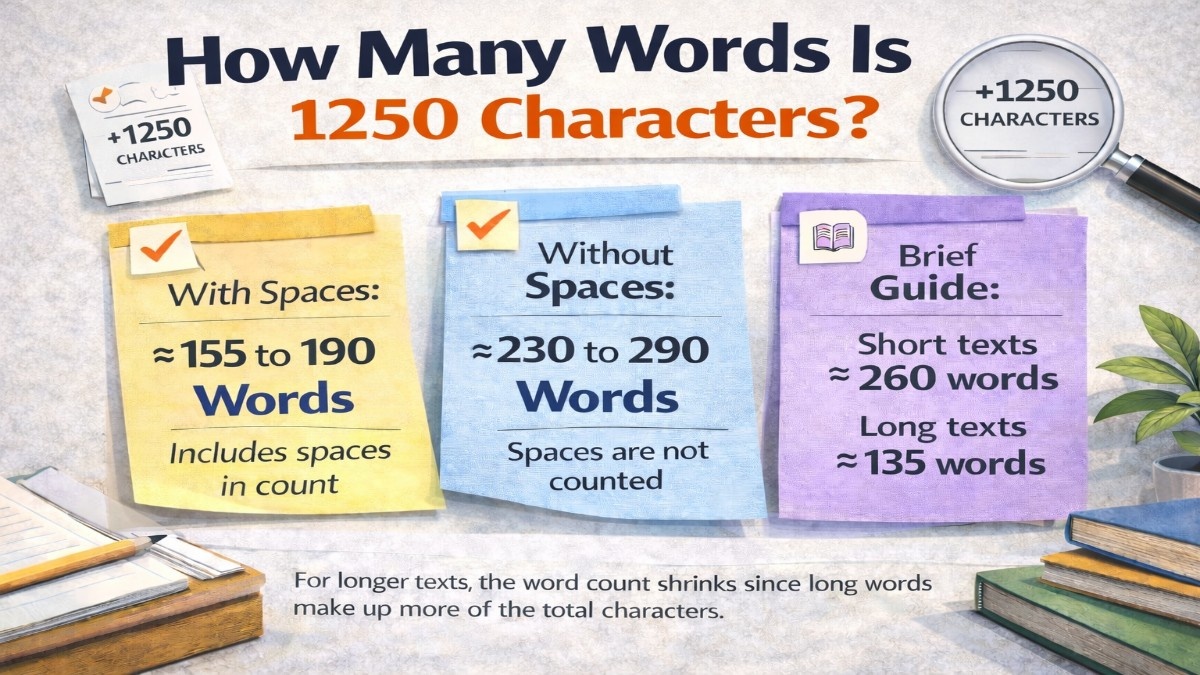
📊 Quick Reference: 1,250 Characters at a Glance
- 1,250 characters with spaces: ~195–220 words
- 1,250 characters without spaces: ~245–265 words
- Estimated reading time: ~1 minute (at 200–250 wpm)
- Equivalent page count: Less than half a double-spaced page (12pt Times New Roman, 1-inch margins)
- Typical use cases: LinkedIn post, Instagram long caption, professional bio, short product description, university supplemental response
Why Do Characters and Words Give Different Numbers?
Characters and words measure text differently, and mixing them up is the most common source of content planning mistakes. A character is every single unit of text — each letter, space, comma, apostrophe, numeral, or emoji. A word is a group of characters separated by whitespace. They are not interchangeable.
According to corpus data from the Oxford English Dictionary, the average English word is 4.7 characters long (excluding the trailing space). Add one space after each word — the standard counting method on nearly every platform — and that rises to 5.7 characters per word. Divide 1,250 by 5.7 and you get approximately 219 words. Divide by 4.7 and you get approximately 266 words. The realistic range of 195–265 accounts for variation in vocabulary, punctuation density, and sentence structure across different writing styles.
🔢 The Formula
Words ≈ Characters (with spaces) ÷ 5.7
Words ≈ Characters (without spaces) ÷ 4.7
Example: 1,250 ÷ 5.7 ≈ 219 words | 1,250 ÷ 4.7 ≈ 266 words
The range exists because English is naturally variable. A passage about "implementation of authentication protocols" uses longer words and hits 1,250 characters faster than one about "how to fix your login page." Both can be exactly 1,250 characters, yet one holds noticeably fewer words.
Does Writing Style Change How Many Words Fit in 1,250 Characters?
Yes — by a surprisingly large margin. The same 1,250-character budget can deliver as few as 170 words in dense academic prose or as many as 250 words in casual conversational writing. That 80-word swing matters enormously when you are writing against a hard cap.
Academic and technical writing relies on polysyllabic vocabulary — "epistemological," "photosynthesis," "infrastructure." These long words exhaust your character budget quickly, yielding a lower word count. Journalistic or social media writing favours short, high-frequency words — "use," "build," "fix," "get" — which pack more words into the same character window.
Punctuation is a silent character-eater too. Em dashes (—), ellipses (…), semicolons, and quotation marks each consume characters without adding words. A stylistically punctuated paragraph will reach 1,250 characters before a plain declarative one — sometimes 30–50 characters sooner.
Character-to-Word Conversion Table (Bookmark This)
Use this reference table for quick estimates across common character counts. All figures use the English average of 5–6 characters per word with spaces included. For an exact count on your actual text, paste it directly into the free word and character counter at WordCounter.vip — it calculates word count, character count (with and without spaces), reading time, and readability score in real time, with no login required.
| Characters | Words | Time |
|---|---|---|
| 85 | ~10–15 | ~5 sec |
| 350 | ~50–70 | ~20 sec |
| 500 | ~80–100 | ~30 sec |
| 600 | ~90–110 | ~30 sec |
| 700 | ~110–130 | ~40 sec |
| 750 | ~120–140 | ~45 sec |
| 800 | ~130–150 | ~45 sec |
| 900 | ~140–160 | ~50 sec |
| 1,000 | ~150–175 | ~1 min |
| 1,200 | ~180–210 | ~1 min |
| 1,250 | ~190–220 | ~1–1.5 min ← you are here |
| 1,300 | ~200–230 | ~1–1.5 min |
| 1,600 | ~250–280 | ~1–2 min |
| 2,000 | ~300–350 | ~1.5 min |
| 2,048 | ~300–360 | ~2 min |
| 2,400 | ~380–420 | ~2 min |
| 2,600 | ~400–450 | ~2–3 min |
| 3,000 | ~450–525 | ~2–3 min |
| 3,200 | ~500–560 | ~3 min |
| 3,500 | ~550–620 | ~3 min |
| 3,600 | ~560–630 | ~3–4 min |
| 3,900 | ~600–680 | ~4 min |
| 4,000 | ~600–700 | ~3 min |
| 4,096 | ~650–720 | ~4 min |
| 5,000 | ~750–880 | ~3–4 min |
| 6,000 | ~900–1,050 | ~4–5 min |
| 6,500 | ~1,000–1,120 | ~5 min |
| 7,000 | ~1,100–1,250 | ~5–6 min |
| 7,500 | ~1,150–1,300 | ~6 min |
| 8,000 | ~1,250–1,400 | ~6 min |
| 9,000 | ~1,400–1,600 | ~7 min |
| 9,600 | ~1,500–1,700 | ~7–8 min |
| 10,000 | ~1,500–1,750 | ~7–8 min |
| 15,000 | ~2,400–2,650 | ~10–12 min |
| 20,000 | ~3,200–3,600 | ~14–16 min |
| 30,000 | ~4,800–5,400 | ~20–25 min |
| 32,000 | ~5,000–5,800 | ~25 min |
| 50,000 | ~8,000–9,000 | ~40–45 min |
| 60,000 | ~9,500–10,800 | ~50–55 min |
| 70,000 | ~11,000–12,500 | ~60+ min |
| 100,000 | ~16,000–18,000 | ~80–90 min |
* Reading time: ~1–1.5 min (200–250 WPM average speed)
How Many Pages Is 1,250 Characters?
At roughly 195–220 words, 1,250 characters fills less than half a double-spaced page — or about 25–30% of a single-spaced page — using Times New Roman 12pt with standard 1-inch margins. In practical terms, it is a well-developed paragraph or a short section of an article.
Font choice shifts the physical footprint. Times New Roman runs roughly 10% more condensed than Arial or Calibri at the same point size, so 1,250 characters in Arial 12pt takes slightly more visible page space than the identical text set in Times New Roman. Formatting matters.
💡 Need an exact page count for your formatting?
The words-per-page calculator at WordCounter.vip lets you set your font, size, line spacing, page dimensions, and margins for a precise estimate. It supports APA, MLA, Chicago, A4, US Letter, and custom formats.
A useful rule of thumb: a standard A4 page at single spacing holds roughly 3,000 characters. That puts 1,250 characters at approximately 42% of a single-spaced A4 page — about the amount of text visible above the fold on most desktop news articles before you scroll.
Where Does a 1,250-Character Limit Actually Appear?
Knowing that 1,250 characters ≈ 200 words lets you plan content without last-minute scrambling. Here is where this specific limit appears in the real world — and how to use that knowledge strategically.
Social Media Platforms
- LinkedIn posts: LinkedIn's feed shows only the first 210 characters before the "see more" cutoff. A 1,250-character post sits firmly in what LinkedIn's own data identifies as the engagement sweet spot — posts between 1,000 and 1,300 characters consistently outperform shorter and longer formats for organic reach among non-newsletter content.
- Instagram captions: Instagram allows up to 2,200 characters, but captions are truncated at roughly 125 characters in the feed. At 1,250 characters, you are writing a long-form caption — ideal for brand storytelling, educational carousels, or community-building content where depth builds trust.
- Facebook posts: Facebook truncates feed previews at around 477 characters. A 1,250-character post requires a "See More" click — which signals genuine reader interest to the algorithm and can positively affect post reach.
Professional and Academic Writing
- Professional bios: Speaker pages, author profiles, and job board bio fields commonly cap entries at 1,000–1,500 characters. A tight 1,250-character bio gives you room for three strong paragraphs covering expertise, credentials, and personality — enough to be memorable, not enough to be self-indulgent.
- University supplemental essays: Platforms like the Coalition App and many university portals use character-based limits (rather than word limits) for short-answer questions, commonly in the 900–1,500 range. Knowing 1,250 characters ≈ 200 words helps you structure a response before you start drafting.
- Product descriptions: Shopify recommends product descriptions of 200–300 words for SEO purposes — landing squarely within the 1,250-character range. Google's Search Central documentation confirms that unique, substantive product copy improves crawl quality and indexing accuracy.
Developer and API Contexts
- SMS marketing: A standard SMS is 160 characters. At 1,250 characters, you are technically spanning 7–8 concatenated message segments. Most modern carriers merge these into one delivery, but billing is per segment. Professional SMS tools cap campaign messages at 160 characters for cost efficiency.
- Database VARCHAR fields: Many CMS platforms and legacy systems define VARCHAR(1250) or similar fields for excerpt, teaser, or summary content. Developers need to translate "1,250 characters" into a meaningful brief for copywriters — the answer is: roughly 200 words.
- AI prompt engineering: OpenAI's GPT-4 processes approximately 1 token per 4 characters in English. That makes 1,250 characters roughly 312 tokens — a compact, focused context window suitable for constrained generation tasks or few-shot examples.
How Does 1,250 Characters Compare to Other Common Limits?
Numbers make more sense when they have neighbours. Here is where 1,250 characters sits in the landscape of limits that writers actually encounter:
- 📱 Twitter / X post limit: 280 characters (~45–50 words)
- 📩 SMS message: 160 characters (~25–28 words)
- 🔍 Google meta description: 155–160 characters (~25–28 words)
- 💼 LinkedIn optimal post: 1,000–1,300 characters (~170–220 words)
- 📝 1,250 characters: ~195–220 words — LinkedIn sweet spot, strong bio, punchy product copy
- 📸 Instagram caption limit: 2,200 characters (~370–390 words)
- 📺 YouTube description cap: 5,000 characters (~840–880 words)
- 📖 Minimum blog length for SEO: ~6,000 characters (~1,000 words)
By that comparison, 1,250 characters is more than four tweets stitched together, nearly eight full SMS messages, and sits right inside LinkedIn's algorithmically preferred content window. It is a meaningful unit — tight enough to force precision, substantial enough to deliver real value.
Is 1,250 Characters Enough for Good SEO Content?
As a standalone blog post? No. At roughly 200 words, 1,250 characters falls well below the 800–1,000 word minimum that most SEO practitioners recommend for indexed content. HubSpot's research consistently shows that articles between 1,000 and 1,500 words generate the most organic search traffic across competitive topics.
That said, 1,250 characters is genuinely powerful within a broader SEO strategy. It is enough for a compelling meta description (truncated at 160 characters in SERPs, but fuller versions serve social previews), a strong product intro, or a well-optimized FAQ answer. Google's own Search Central documentation highlights that succinct, direct answers to common questions improve your chances in featured snippets and AI Overviews — both of which pull from concise, well-structured content blocks.
For platform-native search — LinkedIn, Instagram, YouTube — 1,250 characters is genuinely competitive. LinkedIn's discovery algorithm specifically rewards posts in the 1,000–1,300 character range that open with a hook in the first 210 visible characters before the "see more" gate. Write the hook first. Every time.
📌 SEO tip: Want to audit a competitor's word depth or verify your own page before publishing? The website word count tool at WordCounter.vip counts total words and characters on any live URL in seconds — no browser extension or manual copy-paste required.
7 Practical Tips for Writing Tightly Within 1,250 Characters
A tight character limit is not a cage — it is a forcing function for clarity. Most writers discover their best work happens when the word count gets uncomfortable. Here is how to make every character count:
- Lead with the answer, not the warm-up. You have ~200 words. Opening with three sentences of context before reaching your point wastes roughly 15% of your budget. Start with your key claim, then support it. This also aligns with Google's preference for answer-first content in AI Overviews and featured snippets.
- Keep sentences under 20 words. Flesch-Kincaid readability research shows comprehension drops reliably above 20 words per sentence. Short sentences also use fewer characters per idea — a direct win under any character cap.
- Cut redundant filler phrases. "In order to" → "to." "At this point in time" → "now." "Due to the fact that" → "because." Each swap saves 5–15 characters and sharpens your prose at the same time. Do this ruthlessly.
- Use numerals, not spelled-out numbers. "1,250" is 5 characters. "twelve hundred and fifty" is 24. In data-heavy or instructional writing, numerals win on both clarity and character efficiency.
- Audit every adjective and adverb. If a modifier adds no information the noun alone cannot carry, delete it. "Very important" → "critical." "Extremely fast" → "instant." Fewer characters, sharper meaning.
- Draft long, then cut to fit. Write 270–300 words freely, without watching the counter. Then read for redundancy and trim to your target. Editing into a limit produces better copy than drafting to the exact count from the start — almost every professional editor will tell you this.
- Count with a live tool, not your gut. Eyeballing character count is unreliable. Paste your draft into the real-time counter at WordCounter.vip to see your exact count — with and without spaces — before you post or submit.
Frequently Asked Questions
How many words is 1,250 characters exactly?
1,250 characters equals approximately 195 to 220 words when spaces are included (the default for most platforms). Without spaces, the same 1,250 characters holds roughly 245 to 265 words. The most reliable single estimate is ~219 words, derived from dividing 1,250 by the Oxford English Dictionary corpus average of 5.7 characters per word (including a trailing space).
Is 1,250 characters a lot of text?
It depends entirely on context. For a tweet (280-character limit), 1,250 characters is more than four posts — substantial. For a full essay or blog article, it is a single well-developed paragraph. For a LinkedIn post or Instagram caption, it is a strong, complete piece of content that hits the engagement sweet spot on both platforms.
How long does it take to write 1,250 characters?
An experienced writer can draft 1,250 characters — about 200 words — in 5 to 10 minutes and edit it in another 5. A first-time writer or someone working in a second language may take 20 to 30 minutes to produce a polished result. At this length, the editing stage often takes as long as the drafting stage — which is entirely normal.
Do spaces count in a 1,250-character limit?
On most platforms — yes. Twitter, LinkedIn, Instagram, Microsoft Word, Google Docs, and the vast majority of CMS platforms all count spaces as characters by default. Always check a platform's documentation when the limit is hard-enforced, because the difference between "with spaces" and "without spaces" can shift your word count by 40 or more at the 1,250-character scale.
How many paragraphs is 1,250 characters?
Using a standard paragraph of 100–150 words (600–900 characters), 1,250 characters equals 1 to 2 standard paragraphs. In web writing, where 2–3 sentence paragraphs improve mobile readability, the same 1,250 characters can be structured into 3 to 5 visually distinct blocks.
How many sentences is 1,250 characters?
An average English sentence runs 15–20 words, or roughly 90–120 characters including punctuation and trailing space. That means 1,250 characters contains approximately 10 to 14 sentences. A conversational writer using short punchy sentences fits more; a technical writer using complex compound sentences fits fewer.
How does 1,250 characters differ from 1,200 characters?
The difference is just 50 characters — roughly 8 to 9 additional words. In practical terms, 1,200 characters gives you approximately 210 words and 1,250 characters gives you approximately 219 words. The difference is one short sentence, or a few qualifying phrases. For most writing purposes, you can treat both limits as interchangeable at the planning stage and fine-tune at the editing stage.
Final Answer: How Many Words Is 1,250 Characters?
The direct, verified answer: 1,250 characters equals approximately 195 to 220 words when spaces are counted — or 245 to 265 words if spaces are excluded. The estimate is grounded in the Oxford English Dictionary corpus average of 4.7 characters per English word (5.7 when the trailing space is included), and confirmed by the formula: 1,250 ÷ 5.7 ≈ 219 words.
For practical planning — drafting a LinkedIn post, filling a CMS character field, estimating reading time, or hitting a university application cap — treating 1,250 characters as approximately 200 words is accurate and reliable across most English writing contexts.
One thing worth remembering: a character count is a measurement tool, not a quality signal. A precise, well-structured 190-word response will always outperform a padded, circular 260-word one. Write with intent, stay within your limit, and let the count confirm what good editing already achieved.
Related Articles
BLOG
How Many Words Is 900 Characters?
by Raviraj Bhosale
900 characters equals approximately 130–160 words with spaces. Learn accurate word count conversions, real-world platform limits, and practical writing tips.
BLOG
How Many Words Is 1000 Characters?
by Raviraj Bhosale
1000 characters equals approximately 160–180 words with spaces. Understand the math behind character-to-word conversions with platform examples.
BLOG
How Many Words Is 1200 Characters?
by Raviraj Bhosale
1200 characters equals approximately 180–215 words with spaces. Learn exact word count conversions with examples and formatting tips.