How Many Words Is 8,000 Characters?
By Raviraj Bhosale · Updated September 02, 2026 · 9 min read
Short answer: 8,000 characters equals approximately 1,400 to 1,580 words when spaces are included — the default counting method on every major writing platform today. Strip the spaces out and those same 8,000 characters expand to roughly 1,700 to 1,750 words. Either way, you are looking at a solid, complete long-form blog post, a detailed university short essay, a thorough product review, or a polished LinkedIn article that earns real professional engagement.
Whether you are a blogger planning a content calendar, a developer setting a database field limit, a student checking a submission portal, or a content strategist scoping a pillar page — knowing exactly what 8,000 characters means in real words changes how you plan, draft, and edit. This guide covers the verified math, a full conversion reference table, real-world contexts where 8,000 characters is a meaningful threshold, and practical tips for writing tightly within any character budget.
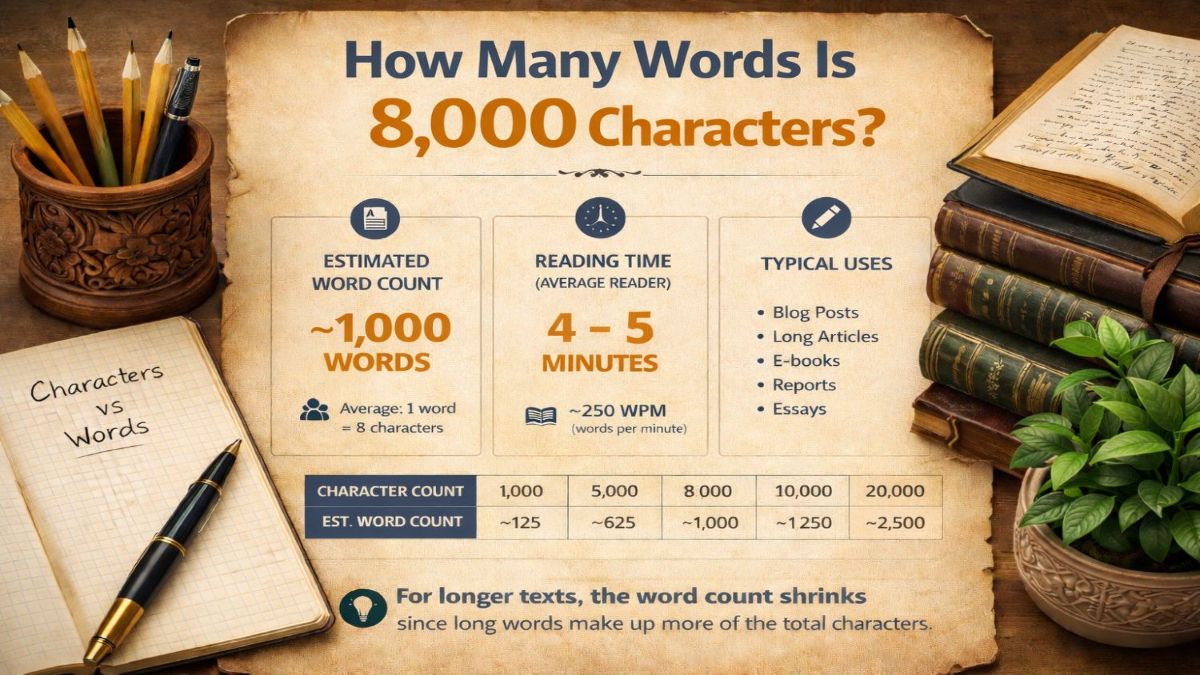
Quick Answer: 8,000 Characters
- With spaces: approximately 1,400–1,580 words
- Without spaces: approximately 1,700–1,750 words
- Double-spaced: roughly 5–6 pages, depending on formatting
- Single-spaced: roughly 2.5–3 pages, depending on formatting
- Reading time: approximately 6–8 minutes for average readers
How Many Words Is 8,000 Characters?
The most useful estimate is about 1,400–1,580 words for 8,000 characters including spaces. This is an estimate rather than a fixed conversion because words do not all have the same length.
8,000 Characters With Spaces
When spaces are counted, 8,000 characters generally produces around 1,400–1,580 English words. Shorter words can produce a higher word count, while longer technical or academic words can produce a lower one.
8,000 Characters Without Spaces
If spaces are excluded before counting, 8,000 characters corresponds to roughly 1,700–1,750 words. The difference exists because spaces consume characters but do not create additional words.
Why Is the Number an Estimate?
A character-to-word conversion depends on the text itself. Academic, legal, and technical writing often uses longer words, while conversational writing tends to use shorter words. Punctuation, numbers, URLs, and formatting can also change the result.
How Do You Convert 8,000 Characters to Words?
A simple estimation method is to divide the character count by an average number of characters per word. For English text, an approximate planning formula is 5.7 characters per word when spaces are included and about 4.7 characters per word when spaces are excluded.
Words ≈ Characters with spaces ÷ 5.7
Words ≈ Characters without spaces ÷ 4.7
Example: 8,000 ÷ 5.7 ≈ 1,404 words
Treat this as a working range rather than an exact mathematical conversion. If you already have the text, counting the actual words is more accurate than estimating from characters.
Does 8,000 Characters Include Spaces and Punctuation?
It depends on the counting method or platform. Many character counters include spaces in their total character count. Punctuation marks such as commas, periods, apostrophes, quotation marks, and hyphens can also contribute to the total.
Characters With Spaces
A count that includes spaces measures the text as it appears, including the spaces between words. This is usually the most useful figure when a website, form, or submission system specifies a total character limit.
Characters Without Spaces
A count without spaces removes the separators between words before calculating the total. Because spaces are excluded, the same text will have a smaller character count without spaces.
Do Punctuation Marks Count as Characters?
Usually, yes. A comma, period, colon, quotation mark, apostrophe, or similar symbol can count as a character. When a limit is strict, check the exact rules of the platform or submission system you are using.
8,000 Characters to Words Conversion Table
Use the conversion table below to compare 8,000 characters with other common character limits. These values are approximate because the actual word count depends on the text.
Character-to-Word Conversion Table (Bookmark This)
Use this reference table for quick estimates across common character counts. All figures use the English average of 5–6 characters per word with spaces included. For an exact count on your actual text, paste it directly into the free word and character counter at WordCounter.vip — it calculates word count, character count (with and without spaces), reading time, and readability score in real time, with no login required.
| Characters | Words | Time |
|---|---|---|
| 85 | ~10–15 | ~5 sec |
| 350 | ~50–70 | ~20 sec |
| 500 | ~80–100 | ~30 sec |
| 600 | ~90–110 | ~30 sec |
| 700 | ~110–130 | ~40 sec |
| 750 | ~120–140 | ~45 sec |
| 800 | ~130–150 | ~45 sec |
| 900 | ~140–160 | ~50 sec |
| 1,000 | ~150–175 | ~1 min |
| 1,200 | ~180–210 | ~1 min |
| 1,250 | ~190–220 | ~1–1.5 min |
| 1,300 | ~200–230 | ~1–1.5 min |
| 1,600 | ~250–280 | ~1–2 min |
| 2,000 | ~300–350 | ~1.5 min |
| 2,048 | ~300–360 | ~2 min |
| 2,400 | ~380–420 | ~2 min |
| 2,600 | ~400–450 | ~2–3 min |
| 3,000 | ~450–525 | ~2–3 min |
| 3,200 | ~500–560 | ~3 min |
| 3,500 | ~550–620 | ~3 min |
| 3,600 | ~560–630 | ~3–4 min |
| 3,900 | ~600–680 | ~4 min |
| 4,000 | ~600–700 | ~3 min |
| 4,096 | ~650–720 | ~4 min |
| 5,000 | ~750–880 | ~3–4 min |
| 6,000 | ~900–1,050 | ~4–5 min |
| 6,500 | ~1,000–1,120 | ~5 min |
| 7,000 | ~1,100–1,250 | ~5–6 min |
| 7,500 | ~1,150–1,300 | ~6 min |
| 8,000 | ~1,250–1,400 | ~6 min ← you are here |
| 9,000 | ~1,400–1,600 | ~7 min |
| 9,600 | ~1,500–1,700 | ~7–8 min |
| 10,000 | ~1,500–1,750 | ~7–8 min |
| 15,000 | ~2,400–2,650 | ~10–12 min |
| 20,000 | ~3,200–3,600 | ~14–16 min |
| 30,000 | ~4,800–5,400 | ~20–25 min |
| 32,000 | ~5,000–5,800 | ~25 min |
| 50,000 | ~8,000–9,000 | ~40–45 min |
| 60,000 | ~9,500–10,800 | ~50–55 min |
| 70,000 | ~11,000–12,500 | ~60+ min |
| 100,000 | ~16,000–18,000 | ~80–90 min |
* Reading time: ~6 min (200–250 WPM average speed)
How Many Pages Is 8,000 Characters?
At approximately 1,400–1,580 words, 8,000 characters usually fills about 5–6 double-spaced pages or around 2.5–3 single-spaced pages. Actual page count changes with font, margins, paper size, line spacing, and paragraph spacing.
8,000 Characters Double-Spaced
A typical 12-point document with standard margins and double spacing may use roughly 5–6 pages. This is a planning estimate rather than a guaranteed page count.
8,000 Characters Single-Spaced
With single spacing and common document formatting, 8,000 characters may occupy around 2.5–3 pages. Different fonts and margin settings can change the result.
8,000-Character Page Estimates
- Double-spaced A4, 12pt: ~5–6 pages
- Single-spaced A4, 12pt: ~2.5–3 pages
- Double-spaced US Letter: ~5.5–6.5 pages
- Single-spaced US Letter: ~2.5–3.5 pages
For an exact estimate for a particular format, use the words-per-page calculator at WordCounter.vip and choose your font, spacing, margins, and page size.
What Does 8,000 Characters Look Like?
An 8,000-character document is substantial enough for a complete article, detailed product review, short academic essay, or professional piece of content. In ordinary English prose, it is commonly around 1,400–1,580 words.
How Many Paragraphs Is 8,000 Characters?
With 100–150 words per conventional paragraph, 8,000 characters can be roughly 9–14 paragraphs. Web writing often uses shorter paragraphs, so the same amount of text may appear as more visual blocks.
How Long Does It Take to Read 8,000 Characters?
Because 8,000 characters is roughly 1,400–1,580 words, reading time is typically around 6–8 minutes at a normal adult reading pace. Dense or technical content may take longer.
8,000 Characters vs. 8,000 Words
These measurements are very different. 8,000 characters is roughly 1,400–1,580 words, while 8,000 words is a much longer document. The character count of 8,000 words depends on word length, spaces, and punctuation.
- 8,000 characters: ~1,400–1,580 words
- 8,000 words: several times longer than an 8,000-character article
How Long Does It Take to Write 8,000 Characters?
Writing time varies with the topic and the amount of research required. A familiar, straightforward article may be drafted in one focused session, while research-heavy work can take considerably longer.
Tips for Staying Within an 8,000-Character Limit
- Lead with the answer. Put the main point near the beginning instead of using a long introduction.
- Remove repetition. Combine sentences that communicate the same idea.
- Use clear H2 and H3 headings. Make a longer page easy to scan.
- Keep examples relevant. Examples should clarify the topic rather than add filler.
- Check the final character count. Different platforms can use different counting rules.
Frequently Asked Questions About 8,000 Characters
How many words is 8,000 characters?
8,000 characters is approximately 1,400–1,580 words with spaces. Without spaces, it is roughly 1,700–1,750 words.
How many words is 8,000 characters including spaces?
With spaces included, 8,000 characters is generally around 1,400–1,580 wordsin English. The exact number depends on word length and punctuation.
How many words are 8,000 characters without spaces?
8,000 characters without spaces is roughly 1,700–1,750 words, although the actual result varies by text.
How many pages is 8,000 characters?
In typical 12-point document formatting, 8,000 characters is about 5–6 double-spaced pages or 2.5–3 single-spaced pages. Formatting can change the result.
How long does it take to read 8,000 characters?
Since 8,000 characters is roughly 1,400–1,580 words, most people can read it in about 6–8 minutes.
How long does it take to write 8,000 characters?
It depends on the writer, topic, research, editing, and proofreading. A familiar topic may take one focused session, while a research-heavy article can take several hours.
Does punctuation count as a character?
In most character-counting systems, punctuation marks count as characters. If you have a strict limit, check whether the specific platform also includes spaces and line breaks.
Does 8,000 characters include spaces?
Often, yes. Many character counters report a total that includes spaces. Some tools also provide a separate count without spaces, so check which figure your requirement uses.
Is 8,000 characters enough for a blog post?
Yes. At roughly 1,400–1,580 words, 8,000 characters can support a complete blog post when the topic is focused and the content directly satisfies the reader's intent.
Final Answer: How Many Words Is 8,000 Characters?
8,000 characters is approximately 1,400–1,580 words when spaces are included. Without spaces, the estimate is about 1,700–1,750 words. The exact word count depends on the words, punctuation, numbers, and formatting in the text.
For planning a blog post, essay, application, report, or other character-limited document, use the range as a guide and check the finished text with a character and word counter for the exact total.
BLOG
How Many Words Is 1300 Characters?
by Raviraj Bhosale
1,300 characters equals approximately 228 words with spaces, or ~277 words without spaces. See the full breakdown, page count, reading time, and real-world platform examples.
BLOG
How Many Words Is 50,000 Characters?
by Raviraj Bhosale
50,000 characters equals approximately 8,772 words with spaces, or ~10,638 words without spaces. See the full breakdown, page count, reading time, and real-world examples.
BLOG
How Many Words Is 350 Characters?
by Raviraj Bhosale
350 characters equals approximately 61 words with spaces, or ~74 words without spaces. See the full breakdown, page count, reading time, and real-world platform examples.