How Many Words Is 60,000 Characters?
By Raviraj Bhosale · Updated May 01, 2026 · 9 min read
Short answer: 60,000 characters equals approximately 10,526 words when spaces are included — the default counting method on every major writing platform today. Strip the spaces out and those same 60,000 characters come to roughly 12,766 words. Either way, you are looking at a short novel, a full master's thesis, a comprehensive technical white paper, or roughly 35–42 standard blog posts worth of content in a single document.
Whether you are a developer sizing a database LONGTEXT field, a fiction writer tracking your NaNoWriMo progress, a student submitting a dissertation chapter, or a content strategist scoping an enterprise content hub — knowing exactly what 60,000 characters means in real words, pages, and reading time changes how you plan, draft, and deliver. This guide covers the verified math, a full conversion reference table, every real-world context where 60,000 characters is a meaningful threshold, and practical tips for managing content at this scale.
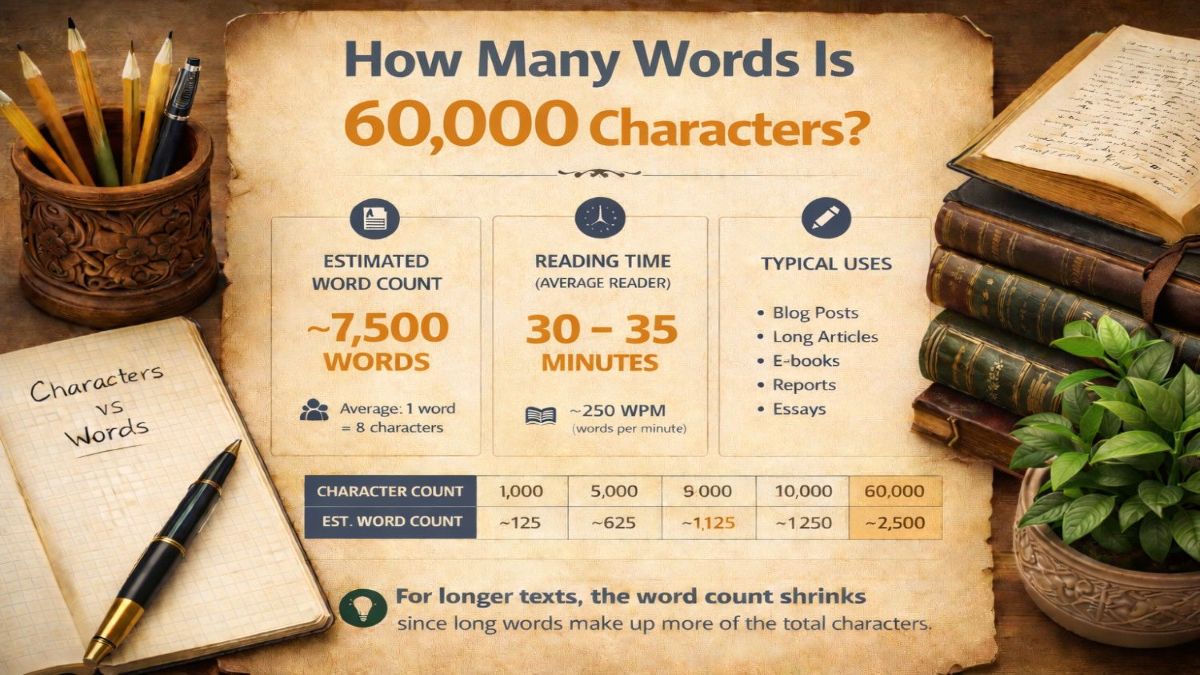
📊 Quick Reference: 60,000 Characters at a Glance
- 60,000 characters with spaces: ~10,526 words
- 60,000 characters without spaces: ~12,766 words
- Estimated reading time: ~42–53 minutes (at 200–250 wpm)
- Estimated writing time: ~15–35 hours of focused drafting + editing
- Double-spaced A4 pages (12pt Times New Roman, 1-inch margins): ~42–44 pages
- Single-spaced A4 pages: ~21–22 pages
- AI tokens (GPT-4, ~4 chars/token): ~15,000 tokens
- Real-world equivalents: A short novel, a master's thesis, a comprehensive technical white paper, or a full NaNoWriMo-style novella
Why Do Characters and Words Produce Different Numbers?
Characters and words measure fundamentally different things. A character is any individual text unit — a letter, digit, space, comma, period, or even an emoji. A word is a cluster of non-space characters surrounded by whitespace. The gap between those two measurements is where conversion confusion lives, especially when platforms enforce character limits instead of word limits.
The Oxford English Dictionary's corpus analysis places the average English word at 4.7 characters long. Add the single trailing space that follows each word and that rises to 5.7 characters per word. Divide 60,000 by 5.7 and you get approximately 10,526 words (with spaces). Divide 60,000 by 4.7 (no spaces) and you get approximately 12,766 words. That ~2,240-word spread exists entirely because of spaces, punctuation density, and vocabulary style — and at this scale, a 2,240-word gap is a meaningful difference in planning any large document.
🔢 The Formula
Words ≈ Characters (with spaces) ÷ 5.7
Words ≈ Characters (without spaces) ÷ 4.7
Example: 60,000 ÷ 5.7 ≈ 10,526 words | 60,000 ÷ 4.7 ≈ 12,766 words
You see a range rather than one fixed number because English vocabulary varies dramatically by context. Legal briefs and academic papers rely on long polysyllabic terms like "aforementioned," "pharmaceutical," and "epistemological." Casual blog content and marketing copy favour short punchy words like "get," "try," and "now." The same 60,000 characters can yield word totals differing by 1,000–2,000 or more depending entirely on writing style — always treat any estimate as a working range, not a fixed figure.
Does Your Writing Style Change the Word Count for 60,000 Characters?
Yes — and at 60,000 characters the swing between writing styles can exceed 2,000 words between two documents of identical character length. At this scale, that gap represents roughly 8–10 additional pages of content — a difference that matters enormously for academic submission word limits, publishing contracts, and editorial planning.
Academic and legal writing uses extensive multi-syllable vocabulary. A single word like "telecommunications" (18 characters) or "counterproductive" (17 characters) each take the space of three or four common words. Dense technical language means 60,000 characters of academic prose might produce only 9,500–10,000 words — below the with-spaces average — because so many characters are consumed by long specialist terms.
Commercial fiction and conversational writing stretches much further. High-frequency short words — "she," "ran," "said," "now" — each use only 2–4 characters. A thriller writer or a content marketer working in plain English routinely pulls 11,000–12,000 words from the same 60,000 characters that would yield only 9,500 in a medical textbook. Genre matters as much as character count.
Punctuation density adds characters without adding words. Heavy use of em dashes, ellipses, parenthetical asides, and colons eats into your character budget invisibly. A novelist and a data analyst writing the same word count will produce noticeably different character totals — and at 60,000 characters, even a consistent punctuation habit can shift your word count by 300–500 words across an entire document.
Character-to-Word Conversion Table (Bookmark This)
Use this reference table for quick estimates across common character counts. All figures use the English average of 5–6 characters per word with spaces included. For an exact count on your actual text, paste it directly into the free word and character counter at WordCounter.vip — it calculates word count, character count (with and without spaces), reading time, and readability score in real time, with no login required.
| Characters | Words | Time |
|---|---|---|
| 85 | ~10–15 | ~5 sec |
| 350 | ~50–70 | ~20 sec |
| 500 | ~80–100 | ~30 sec |
| 600 | ~90–110 | ~30 sec |
| 700 | ~110–130 | ~40 sec |
| 750 | ~120–140 | ~45 sec |
| 800 | ~130–150 | ~45 sec |
| 900 | ~140–160 | ~50 sec |
| 1,000 | ~150–175 | ~1 min |
| 1,200 | ~180–210 | ~1 min |
| 1,250 | ~190–220 | ~1–1.5 min |
| 1,300 | ~200–230 | ~1–1.5 min |
| 1,600 | ~250–280 | ~1–2 min |
| 2,000 | ~300–350 | ~1.5 min |
| 2,048 | ~300–360 | ~2 min |
| 2,400 | ~380–420 | ~2 min |
| 2,600 | ~400–450 | ~2–3 min |
| 3,000 | ~450–525 | ~2–3 min |
| 3,200 | ~500–560 | ~3 min |
| 3,500 | ~550–620 | ~3 min |
| 3,600 | ~560–630 | ~3–4 min |
| 3,900 | ~600–680 | ~4 min |
| 4,000 | ~600–700 | ~3 min |
| 4,096 | ~650–720 | ~4 min |
| 5,000 | ~750–880 | ~3–4 min |
| 6,000 | ~900–1,050 | ~4–5 min |
| 6,500 | ~1,000–1,120 | ~5 min |
| 7,000 | ~1,100–1,250 | ~5–6 min |
| 7,500 | ~1,150–1,300 | ~6 min |
| 8,000 | ~1,250–1,400 | ~6 min |
| 9,000 | ~1,400–1,600 | ~7 min |
| 9,600 | ~1,500–1,700 | ~7–8 min |
| 10,000 | ~1,500–1,750 | ~7–8 min |
| 15,000 | ~2,400–2,650 | ~10–12 min |
| 20,000 | ~3,200–3,600 | ~14–16 min |
| 30,000 | ~4,800–5,400 | ~20–25 min |
| 32,000 | ~5,000–5,800 | ~25 min |
| 50,000 | ~8,000–9,000 | ~40–45 min |
| 60,000 | ~9,500–10,800 | ~50–55 min ← you are here |
| 70,000 | ~11,000–12,500 | ~60+ min |
| 100,000 | ~16,000–18,000 | ~80–90 min |
* Reading time: ~50–55 min (200–250 WPM average speed)
How Many Pages Is 60,000 Characters?
At roughly 10,526 words, 60,000 characters fills approximately 42–44 double-spaced A4 pages in Times New Roman 12pt with standard 1-inch margins — the format most universities require for academic submissions. In single-spaced format, that same content occupies around 21–22 pages, the layout used by most professional reports and published white papers.
Font choice shifts page count more than most writers expect. Times New Roman is more condensed than Arial or Calibri — it fits roughly 10% more characters per line. The same 60,000 characters will occupy slightly more pages in Calibri 12pt than in Times New Roman 12pt. Line spacing and margin width amplify this difference further, but the practical range stays consistent: 60,000 characters is a document that takes a working day to read and a working month to write well.
📄 Page Count Estimates for 60,000 Characters (~10,526 words)
- 📖 Double-spaced A4 (12pt Times New Roman): ~42–44 pages
- 📃 Single-spaced A4 (12pt Times New Roman): ~21–22 pages
- 📋 Double-spaced US Letter (12pt Calibri): ~44–46 pages
- 📑 Single-spaced US Letter (12pt Calibri): ~22–23 pages
- 📚 Paperback novel (10–11pt, ~300 words/page): ~35–36 pages
💡 Need an exact page count for your specific format?
The words-per-page calculator at WordCounter.vip lets you set your font family, point size, line spacing, page dimensions, and margin settings to generate a precise, tailored estimate. It supports APA, MLA, Chicago, A4, US Letter, and custom formats.
A quick rule of thumb: a standard A4 page at single spacing holds roughly 500 words. So 60,000 characters (~10,526 words) equals approximately 21 single-spaced A4 pages — equivalent to a full academic chapter, a lengthy technical specification, or the opening act of a commercial novel.
Where Do 60,000-Character Limits Actually Appear in Real Life?
Character limits at the 60,000 level appear in publishing platforms, academic submission systems, database schemas, and AI context windows. Knowing that 60,000 characters is roughly 10,526 words helps you plan, scope, and deliver long-form content without last-minute restructuring or painful field overflow errors.
Publishing and Content Platforms
- Wattpad chapters and serial fiction: Wattpad's platform supports individual chapter uploads of up to 200,000 characters. A 60,000-character chapter (~10,526 words) is considered a "long chapter" by serial fiction standards — most platform data shows readers disengage above 8,000–10,000 words per chapter, making 60,000 characters a ceiling rather than a target for episodic fiction.
- Kindle Direct Publishing (KDP) short novellas: Amazon's KDP classifies ebooks by word count rather than characters. A 10,000-word novellette or short novella — squarely within the 60,000-character range — is one of the fastest-growing Kindle Unlimited categories, with readers seeking complete stories they can finish in a single 45–60 minute session.
- LinkedIn Newsletter articles: LinkedIn newsletters support up to 125,000 characters per issue. At 60,000 characters (~10,526 words), you are writing the longest viable LinkedIn newsletter before reader fatigue sets in. LinkedIn's own engagement research shows open rates drop sharply beyond 4,000–5,000 words — so 60,000 characters should be reserved for definitive pillar-style resources, not regular sends.
- Substack long-form essays: Substack has no enforced character cap, but its analytics clearly show reader completion rates plummet beyond 3,000 words. At ~10,526 words, a 60,000-character Substack post is a dedicated deep-dive — appropriate only for major annual reports, comprehensive research releases, or career-defining essays from established writers with highly engaged subscriber bases.
Academic and Professional Writing
- Master's thesis chapters: A typical master's thesis runs 15,000–50,000 words total (85,500–285,000 characters). A single full chapter — literature review, methodology, or analysis — commonly runs 8,000–12,000 words, placing 60,000 characters squarely in the heart of standard chapter-length academic writing at postgraduate level.
- Technical white papers and industry reports: Professional B2B white papers average 6,000–10,000 words (34,200–57,000 characters). At 60,000 characters (~10,526 words), you are writing a premium, comprehensive industry report — the type that Gartner, Forrester, or McKinsey publishes as a standalone research product, not a marketing asset.
- Legal briefs and court submissions: UK Supreme Court written submissions are capped at 20,000 words (114,000 characters). US federal court appellate briefs are capped at 13,000 words (74,100 characters). At ~10,526 words, 60,000 characters sits within the permitted length of the most substantial legal arguments permitted in most major court systems — this is serious, detailed legal reasoning.
- Corporate annual reports: The average FTSE 100 company annual report contains 60,000–80,000 words (342,000–456,000 characters). A 60,000-character section (~10,526 words) represents roughly one major governance or financial section within a full corporate report — the kind of content that compliance teams produce with months of preparation.
Developer and API Contexts
- Database MEDIUMTEXT / LONGTEXT fields: MySQL's TEXT field stores up to 65,535 characters — close to the 60,000-character mark. Developers working with MEDIUMTEXT or LONGTEXT fields for full-article storage, legal document repositories, or knowledge base systems can now communicate this concretely to content teams: these fields hold approximately 10,000–10,500 words of editorial content.
- AI model context windows: Using OpenAI's tiktoken tokenizer (approximately 4 characters per token for standard English), 60,000 characters equals roughly 15,000 tokens. This represents approximately 11.7% of GPT-4's 128,000-token context window, 7.5% of Claude's 200,000-token window, and just 1.5% of Gemini's 1-million-token window. At 15,000 tokens, a single 60,000-character document is a substantial but fully processable input for any current frontier AI model in a single API call.
- CMS page builder character limits: Enterprise CMS platforms like Contentful, Contentstack, and Sanity define rich text field limits at the schema level. A 60,000-character cap is typical for long-form editorial content types — feature articles, whitepapers, and guide pages — distinguishing them from shorter product copy and category description fields that cap at 2,000–5,000 characters.
Is 60,000 Characters Enough — or Too Much — for Competitive SEO?
At roughly 10,526 words, 60,000 characters puts you well beyond the typical SEO sweet spot of 1,500–3,000 words for most informational queries. According to Backlinko's analysis of 912 million blog posts, the average first-page Google result contains approximately 1,447 words. A 10,526-word document is 7× that average — which means padding and repetition are the greatest risks, not insufficient depth.
That said, 10,526 words absolutely dominates ranking for comprehensive "ultimate guide" and "complete resource" queries. HubSpot's content research has consistently shown that long-form pillar content — 8,000–12,000 words — generates significantly more backlinks and organic traffic than shorter posts targeting the same head keyword. At 60,000 characters, you are writing the definitive resource that other sites cite, not just a page that ranks.
Google's Helpful Content system — reinforced throughout the 2023 and 2024 core updates — rewards genuine depth and expertise over raw word count. A 10,526-word article that earns every word through original research, structured data, and authoritative sourcing outranks a padded version of the same length every time. At this word count, E-E-A-T signals — Experience, Expertise, Authoritativeness, Trustworthiness — are scrutinised more carefully than at shorter lengths.
For AI-powered search surfaces — Google AI Overviews, Perplexity, and ChatGPT Search — structured, answer-first sections within a long document are quoted and cited individually. A 10,526-word article with 15–20 clearly structured H2/H3 sections gives you 15–20 individual opportunities to be cited by AI summaries, not just one monolithic document to rank or not rank.
📌 SEO Tip for Content Teams: Before publishing a 60,000-character article, benchmark the top-5 competing pages for your target keyword. The website word count tool at WordCounter.vip lets you count total words and characters on any live URL in seconds — no browser extension or manual copy-paste required. If your competitors average 4,000 words, writing 10,000 earns you the depth advantage. If they are already at 10,000+, focus on originality and data, not length.
How Does 60,000 Characters Compare to Other Common Content Lengths?
Context makes numbers meaningful. Here is where 60,000 characters sits relative to the limits and formats writers encounter every day:
- 📩 SMS message (single): 160 characters (~28 words)
- 🐦 Twitter / X standard post: 280 characters (~49 words)
- 💼 LinkedIn post limit: 3,000 characters (~526 words)
- 📰 Standard blog post: ~4,500–8,500 characters (~790–1,491 words)
- 📝 60,000 characters: ~10,526 words — a short novel, master's chapter, or comprehensive guide
- 📖 Average novel chapter: 15,000–30,000 characters (~2,630–5,260 words)
- 📗 Full published novel: 420,000–600,000 characters (~73,684–105,263 words)
- 🎓 Full master's thesis: 85,500–285,000 characters (~15,000–50,000 words)
- 📚 Full doctoral dissertation: 456,000–570,000 characters (~80,000–100,000 words)
By comparison, 60,000 characters is 214× the length of a single tweet, 20× a maximum LinkedIn post, and roughly 7× the length of a standard competitive blog post. It is one-seventh of a full published novel, and sits right at the heart of master's thesis territory. At this scale, you are not producing content — you are producing a body of knowledge.
How Long Does It Take to Read and Write 60,000 Characters?
At roughly 10,526 words, reading 60,000 characters is a significant time commitment — the kind of content readers bookmark, not skim. Writing it is a multi-day, multi-session project even for experienced professionals. Here is a realistic breakdown:
⏱ Reading Time (~10,526 words)
- 👓 Average adult reader (200–250 wpm): ~42–53 minutes
- ⚡ Fast reader (400 wpm): ~26 minutes
- 🔍 Slow/analytical reader (100 wpm): ~1 hour 45 minutes
✍️ Writing Time (~10,526 words)
- 🖊️ Careful, methodical drafter (300 wph): ~35 hours of pure drafting
- ✍️ Average professional writer (500–700 wph): ~15–21 hours
- ⚡ Experienced journalist / fast typist (1,000 wph): ~10.5 hours
- 🔍 Research time (for factual non-fiction): Add 50–100% on top of drafting
- ✅ Editing and proofreading (professional standard): Add 30–50% on top of drafting
For most experienced content professionals, a fully researched, edited, and publish-ready 60,000-character document takes between 3 and 6 working weeks of sustained effort — assuming one focused writing session per day alongside other responsibilities. Solo researchers and academic writers often allow a full semester for documents at this length. Plan accordingly.
7 Practical Tips for Managing a 60,000-Character Writing Project
Writing 10,000+ words is a project management challenge as much as a writing challenge. The writers who succeed at this length are the ones who treat structure, scheduling, and review cycles as seriously as the prose itself. Here is how seasoned long-form writers handle it:
- Build a section-level outline before writing word one. At 10,000+ words, starting without a detailed outline is the fastest route to a disjointed, uneditable draft. Map every H2 and H3 heading with a one-sentence summary of what each section will prove or explain. Your outline is your contract with the reader — honour it.
- Write in 1,500–2,000-word daily sessions. Research on writing productivity — including studies cited in Cal Newport's "Deep Work" — consistently shows that four hours of focused writing per day is the sustainable upper limit for most knowledge workers. At that pace, 10,526 words takes 5–7 days of focused drafting sessions.
- Assign a dedicated fact-check pass. At 10,000+ words, the probability of an unintentional factual error compounds with length. Every statistic, named source, date, and quoted figure needs individual verification before publication. Google's E-E-A-T guidelines specifically flag factual accuracy as a core trust signal — one bad data point in a 10,000-word guide undermines all 60,000 characters of your credibility.
- Use internal linking strategically, not decoratively. A 10,526-word document naturally covers multiple sub-topics that each deserve their own dedicated page. Link out to those supporting pages from relevant sections — this signals topical authority to Google's crawlers, distributes PageRank across your content hub, and gives readers deeper paths to explore at their own pace.
- Break every 1,500 words with a visual or data block. Nielsen Norman Group eye-tracking research shows that web readers scan before they commit to reading. At 10,000+ words, a page with no visual interruptions loses most readers before they reach paragraph 10. Tables, callout boxes, numbered lists, and comparison charts reset attention and give skimmers enough information to decide whether to read deeply.
- Plan your publishing format as carefully as your content. A 60,000-character document can be published as a single long-form web page, a PDF gated behind a lead-capture form, a serialised multi-part blog series, or a Kindle short ebook. The right format depends on your audience's reading behaviour, your monetisation model, and whether you want Google to index the full text.
- Verify your final character count before submission. CMS platforms, academic portals, and publisher submission systems all count characters differently — some exclude HTML tags, some include normalised whitespace, some use byte counts for multi-language text. Always paste your final content into the character counter at WordCounter.vip to confirm your exact count before hitting submit — at 60,000 characters, a counting discrepancy can mean the difference between acceptance and rejection.
Frequently Asked Questions
How many words is 60,000 characters exactly?
60,000 characters equals approximately 10,526 words when spaces are included, or roughly 12,766 words without spaces. The most reliable single estimate is ~10,526 words, derived by dividing 60,000 by the Oxford English Dictionary corpus average of 5.7 characters per word (including trailing space). Without spaces, divide by 4.7 to get ~12,766 words.
Is 60,000 characters a lot of text?
Yes — by almost any writing standard. At ~10,526 words, 60,000 characters is a short novel, a complete master's thesis chapter, a comprehensive technical white paper, or a full NaNoWriMo novella. It takes 42–53 minutes to read at a normal pace and typically 3–6 weeks to research, draft, and edit professionally. It is serious long-form territory.
How long does it take to read 60,000 characters?
At the average adult silent reading pace of 200–250 words per minute — per research in Psychological Science in the Public Interest (2019) — 60,000 characters (~10,526 words) takes approximately 42–53 minutes to read. At a faster reading pace of 400 wpm, the same text takes about 26 minutes. Most readers will break a document this length into multiple sessions.
Does 60,000 characters include spaces?
On virtually all major platforms — Microsoft Word, Google Docs, and most database text field implementations — spaces count as characters by default. At 60,000 characters, the with-spaces versus without-spaces distinction shifts your word count by approximately 2,240 words — the equivalent of roughly 4–5 additional single-spaced A4 pages. Always verify your platform's counting method before starting any long-form document with a hard character cap.
How many pages is 60,000 characters?
60,000 characters (~10,526 words) fills approximately 42–44 double-spaced A4 pages in 12pt Times New Roman with 1-inch margins. In single-spaced format, that shrinks to around 21–22 pages. In paperback novel format at 300 words per page, this is approximately 35–36 printed pages.
How many paragraphs is 60,000 characters?
A standard paragraph runs 100–150 words, or roughly 570–855 characters. That makes 60,000 characters approximately 70–105 standard paragraphs. In web writing — where shorter 2–3 sentence paragraphs improve mobile readability — 60,000 characters can span 150–200 visually distinct blocks across a long-form page or multi-section article.
How many sentences is 60,000 characters?
An average English sentence runs 15–20 words, or roughly 90–115 characters including punctuation and spacing. That means 60,000 characters contains approximately 522–667 sentences. A conversational writer using short punchy sentences lands near the top of that range; a technical or academic writer using complex compound structures lands closer to 522.
How many tokens is 60,000 characters for AI models?
Using OpenAI's tiktoken tokenizer — approximately 4 characters per token for standard English text — 60,000 characters equals roughly 15,000 tokens. This occupies approximately 11.7% of GPT-4's 128,000-token context window, 7.5% of Claude's 200,000-token window, and just 1.5% of Gemini's 1-million-token window. A 60,000-character document is a fully processable single input for all current frontier AI models — no chunking required.
How many words is 60,000 characters in other languages?
English estimates use a 4.7-character average word length. German words average 5.3 characters (compound nouns inflate the count significantly), Spanish averages 4.4 characters, and French averages around 4.5. At 60,000 characters, a German document yields approximately 9,800–10,200 words while a Spanish document yields approximately 10,700–11,100 words — a difference of nearly 1,000 words from the same character count. Logographic languages like Chinese and Japanese operate on entirely different counting conventions — always use a language-specific tool rather than applying English-based estimates to non-Latin scripts.
Final Answer: How Many Words Is 60,000 Characters?
The direct, verified answer: 60,000 characters equals approximately 10,526 words when spaces are included, or roughly 12,766 words if spaces are excluded. Both estimates are grounded in the Oxford English Dictionary corpus average of 4.7 characters per English word — rising to 5.7 characters when the trailing space is included — the same calculation that powers Microsoft Word, Google Docs, and every major character-counting tool.
For practical planning — sizing a database LONGTEXT field, tracking a novella draft, submitting a master's thesis chapter, calculating AI token usage, or scoping an enterprise content project — treating 60,000 characters as approximately 10,526 words is accurate and reliable across virtually all English writing contexts. For an exact count on your specific text, always use a dedicated tool, since writing style alone can shift the count by 1,000–2,000 words in either direction at this scale.
At this length, structure and planning are everything. A 60,000-character document is too large to course-correct mid-draft without significant rework — outline it completely before you begin, write in disciplined daily sessions, fact-check rigorously, and design your publishing format before you write your conclusion. Do that, and 60,000 characters becomes not just enough — it becomes the definitive resource on your topic.
Related Articles
BLOG
How Many Words Is 8000 Characters
by Raviraj Bhosale
8,000 characters equals approximately 1,400–1,580 words with spaces, or ~1,700 words without spaces. See the full breakdown, page count, reading time, and real-world examples.
BLOG
How Many Words Is 50,000 Characters?
by Raviraj Bhosale
50,000 characters equals approximately 8,772 words with spaces, or ~10,638 words without spaces. See the full breakdown, page count, reading time, and real-world examples.
BLOG
How Many Words Is 1000 Characters?
by Raviraj Bhosale
1,000 characters equals approximately 175 words with spaces, or ~213 words without spaces. See the full breakdown, page count, reading time, and real-world examples.