How Many Words Is 600 Characters?
By Raviraj Bhosale · Updated April 17, 2026 · 8 min read
Short answer: 600 characters equals approximately 100 to 120 words when spaces are included — which is the default counting method on virtually every writing platform and word processor today. Strip the spaces out, and those same 600 characters stretch to roughly 125 to 130 words. Either way, you are looking at a focused, punchy content block: enough for a sharp social media caption, a concise email opener, or one solid paragraph in a longer piece.
Whether you are a student hitting a character cap on a university portal, a marketer crafting a product description, or a developer setting a database field limit — the precise word count matters. This guide covers the core math, a reference conversion table, real platforms that use 600-character limits, and practical tips for writing cleanly within that budget.
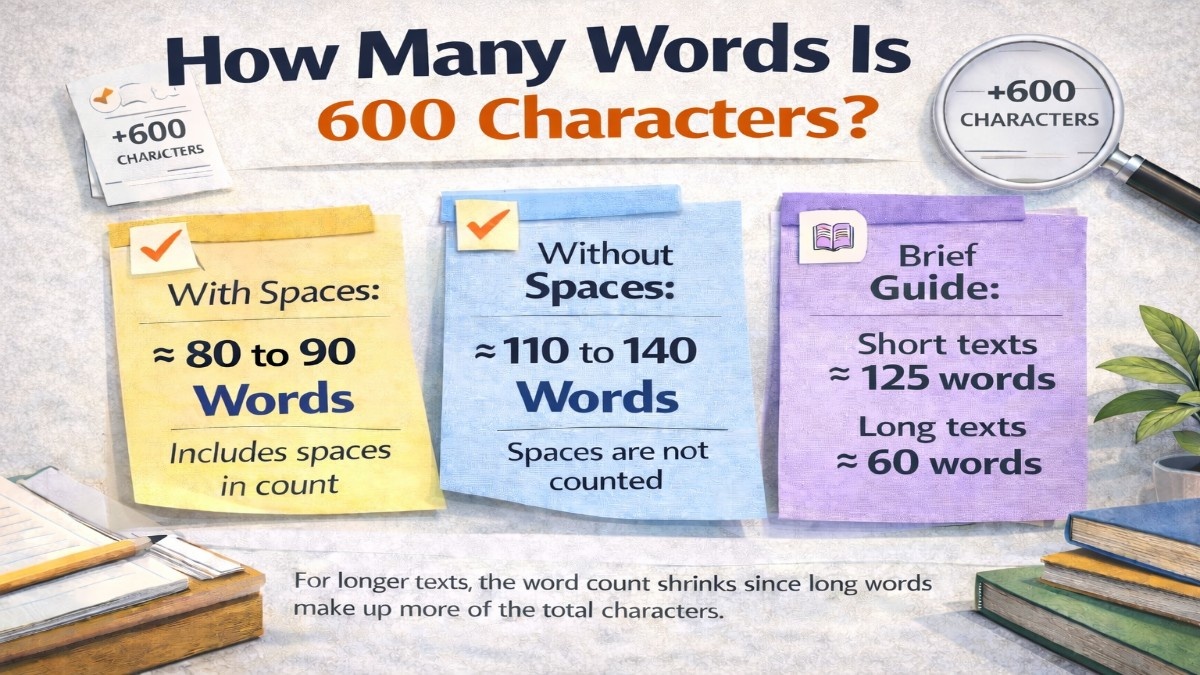
📊 Quick Reference: 600 Characters at a Glance
- 600 characters with spaces: ~100–120 words
- 600 characters without spaces: ~125–130 words
- Estimated reading time: ~25–30 seconds (at 200–250 wpm)
- Equivalent page length: Roughly one-quarter of a double-spaced A4 page (12pt Times New Roman)
- Common use cases: Instagram captions, short product descriptions, app store update notes, SMS campaigns, LinkedIn comment replies, university short-answer responses
Why Do Characters and Words Produce Different Numbers?
Characters and words measure fundamentally different things — and confusing them is one of the most common planning mistakes in content writing. A character is any single unit of text: a letter, a digit, a space, a comma, an apostrophe, or even an emoji. A word is a group of characters separated by whitespace.
Corpus data from the Oxford English Dictionary places the average English word length at 4.7 characters. Add the single space that follows most words and that rises to 5.7 characters per word. Divide 600 by 5.7 and you land at approximately 105 words. Divide 600 by 4.7 (no spaces) and you get approximately 127 words. That 100–130 range accounts for natural variation in vocabulary, punctuation density, and writing style.
Here is the formula that powers every estimate in this article:
Words ≈ Characters (with spaces) ÷ 5.7
Words ≈ Characters (without spaces) ÷ 4.7
Example: 600 ÷ 5.7 ≈ 105 words | 600 ÷ 4.7 ≈ 127 words
You see a range — not a single fixed number — because English word length varies naturally by context. Legal and academic writing leans on polysyllabic terms like "pharmaceutical" or "epistemological." Casual marketing copy relies on short, punchy words like "get," "fix," and "try." Both can hit 600 characters while producing word totals that differ by 20 or more.
Does Writing Style Change How Many Words Fit in 600 Characters?
Yes — significantly more than most writers expect. The same 600-character budget can yield anywhere from around 85 words in dense technical prose to approximately 125 words in casual, conversational copy. That 40-word gap matters a lot when a hard character limit is involved.
Academic and legal writing uses multi-syllable vocabulary. Long words consume characters quickly, pulling your total word count down. Casual, journalistic writing favours high-frequency short words, which pack far more words into the same character budget without sacrificing clarity.
Punctuation matters too. Em dashes, ellipses, quotation marks, and semicolons all use character slots without contributing to word count. A text heavy on punctuation for rhythm will hit 600 characters faster than clean, declarative prose.
Character-to-Word Conversion Table (Bookmark This)
Use this reference table for quick estimates across common character counts. All figures use the English average of 5–6 characters per word with spaces included. For an exact count on your actual text, paste it directly into the free word and character counter at WordCounter.vip — it calculates word count, character count (with and without spaces), reading time, and readability score in real time, with no login required.
| Characters | Words | Time |
|---|---|---|
| 85 | ~10–15 | ~5 sec |
| 350 | ~50–70 | ~20 sec |
| 500 | ~80–100 | ~30 sec |
| 600 | ~90–110 | ~30 sec ← you are here |
| 700 | ~110–130 | ~40 sec |
| 750 | ~120–140 | ~45 sec |
| 800 | ~130–150 | ~45 sec |
| 900 | ~140–160 | ~50 sec |
| 1,000 | ~150–175 | ~1 min |
| 1,200 | ~180–210 | ~1 min |
| 1,250 | ~190–220 | ~1–1.5 min |
| 1,300 | ~200–230 | ~1–1.5 min |
| 1,600 | ~250–280 | ~1–2 min |
| 2,000 | ~300–350 | ~1.5 min |
| 2,048 | ~300–360 | ~2 min |
| 2,400 | ~380–420 | ~2 min |
| 2,600 | ~400–450 | ~2–3 min |
| 3,000 | ~450–525 | ~2–3 min |
| 3,200 | ~500–560 | ~3 min |
| 3,500 | ~550–620 | ~3 min |
| 3,600 | ~560–630 | ~3–4 min |
| 3,900 | ~600–680 | ~4 min |
| 4,000 | ~600–700 | ~3 min |
| 4,096 | ~650–720 | ~4 min |
| 5,000 | ~750–880 | ~3–4 min |
| 6,000 | ~900–1,050 | ~4–5 min |
| 6,500 | ~1,000–1,120 | ~5 min |
| 7,000 | ~1,100–1,250 | ~5–6 min |
| 7,500 | ~1,150–1,300 | ~6 min |
| 8,000 | ~1,250–1,400 | ~6 min |
| 9,000 | ~1,400–1,600 | ~7 min |
| 9,600 | ~1,500–1,700 | ~7–8 min |
| 10,000 | ~1,500–1,750 | ~7–8 min |
| 15,000 | ~2,400–2,650 | ~10–12 min |
| 20,000 | ~3,200–3,600 | ~14–16 min |
| 30,000 | ~4,800–5,400 | ~20–25 min |
| 32,000 | ~5,000–5,800 | ~25 min |
| 50,000 | ~8,000–9,000 | ~40–45 min |
| 60,000 | ~9,500–10,800 | ~50–55 min |
| 70,000 | ~11,000–12,500 | ~60+ min |
| 100,000 | ~16,000–18,000 | ~80–90 min |
* Reading time: ~30 sec (200–250 WPM average speed)
How Many Pages Is 600 Characters?
At roughly 100–120 words, 600 characters fills approximately one-quarter of a double-spaced page — or about one-eighth of a single-spaced page — in Times New Roman 12pt with standard 1-inch margins. In plain terms: it is a tight, focused paragraph, not a full page.
Font choice does shift the physical space slightly. Times New Roman is more condensed than Arial or Calibri, fitting roughly 10% more characters per line. So 600 characters in Arial 12pt occupies marginally more page space than the same text set in Times New Roman 12pt.
💡 Need an exact page count for your format?
The words-per-page calculator at WordCounter.vip lets you set your font, point size, line spacing, page dimensions, and margins to generate a precise, tailored estimate. It supports APA, MLA, Chicago, A4, US Letter, and custom formats.
A reliable rule of thumb: a standard A4 page at single spacing holds roughly 3,000 characters. That makes 600 characters about 20% of a single-spaced A4 page — roughly what you read in the very first paragraph of most web articles before your eye even reaches the first subheading.
Where Does a 600-Character Limit Actually Appear?
Knowing that 600 characters translates to roughly 105–120 words lets you plan content efficiently — no frantic cutting at the last second, no editor trimming your best line. Here is exactly where this specific limit shows up across platforms and real-world use cases.
Social Media and Messaging Platforms
Instagram captions support up to 2,200 characters in total, but the platform truncates the visible preview at roughly 125 characters before the "more" link appears. Fitting your key message inside the first 600 characters ensures it lands before any tap is required — critical for engagement on mobile, where most Instagram browsing happens.
LinkedIn recommendations are often written in the 400–700 character range. A 600-character recommendation is long enough to feel genuine and specific, but short enough that the recipient's connections will actually read it in full. Sprout Social's 2024 Content Benchmarks report found that comments and recommendations under 700 characters consistently generate higher response rates than longer ones.
On many SMS marketing platforms — including Twilio, Klaviyo, and HubSpot SMS — a single SMS message is capped at 160 characters. A 600-character campaign message segments into four separate SMS units. Marketers who keep broadcast messages to 600 characters or fewer often use this budget for a complete offer, a call-to-action, and a short opt-out line.
Professional and Academic Writing
Many university supplemental essay prompts — particularly on the Common App and Coalition Application platforms — use character limits in the 500–800 character range for short-answer questions. A 600-character response gives you room for one focused argument: a claim, a piece of supporting evidence, and a clean closing sentence. No room for waffle.
Job boards like Indeed, Glassdoor, and LinkedIn recommend keeping headline and skill-summary fields under 600 characters for optimal mobile readability. Some applicant tracking systems (ATS) — including Greenhouse and Lever — parse and display only the first 600 characters of structured text fields, making front-loading your key credentials a practical and important strategy.
Developer and API Contexts
In software development, VARCHAR(600) appears as a common database column definition for fields like product taglines, push notification bodies, and short user bios. Developers working with these constraints need to translate "600 characters" into meaningful content guidance for their copywriting teams. Now you can tell them: roughly 105 words, or one tight paragraph.
Push notification bodies on Android support up to 256 characters in the collapsed view and up to 1,000 characters in the expanded BigTextStyle layout. A 600-character notification body occupies the expanded format cleanly — enough for a complete message with a call-to-action. For OpenAI's GPT-4o, 600 characters equals roughly 150 tokens — a compact and focused instruction block.
How Does 600 Characters Compare to Other Common Limits?
Numbers make more sense alongside familiar benchmarks. Here is where 600 characters sits in the landscape of limits that writers, marketers, and developers encounter daily:
- 📩 SMS message: 160 characters (~25–28 words)
- 🔍 Google meta description: 155–160 characters (~25–28 words)
- 📱 Twitter / X post limit: 280 characters (~45–50 words)
- 🟢 600 characters: ~100–120 words — a solid paragraph or sharp email opener
- 💼 LinkedIn post (optimal range): ~1,000–1,300 characters (~170–220 words)
- 📸 Instagram caption limit: 2,200 characters (~370–385 words)
- 📺 YouTube description (above the fold): ~157 characters before "Show more"
- 📖 Minimum SEO blog post length: ~6,000 characters (~1,000 words)
By comparison, 600 characters is more than twice a Twitter post, nearly four times a Google meta description, and about half the LinkedIn engagement sweet spot. It is focused enough to carry a single clear idea — and tight enough that every word has to justify its place.
Is 600 Characters Enough for Good SEO Content?
For a standalone indexed blog post? No — 600 characters falls significantly short of the 800–1,000 word minimum that SEO practitioners typically recommend for competitive search terms. HubSpot's content research consistently finds that articles between 1,000 and 1,500 words generate the highest organic traffic on most topics.
That said, 600 characters is genuinely powerful within a broader SEO content strategy. It is enough for a compelling FAQ answer, a strong product page intro paragraph, or a meta description body. Google's Search Central documentation specifically notes that direct, succinct answers to common questions improve eligibility for Featured Snippets and AI Overviews — both of which pull from well-structured, concise content blocks.
For platform-native discovery — optimising Instagram captions, LinkedIn posts, or app store descriptions — 600 characters is a strong, competitive content unit. Apple's App Store indexes the full description text for keyword relevance, even though only the first 255 characters appear before the "more" gate.
📌 SEO tip: Before publishing any piece — 600 characters or 6,000 — run it through the website word count tool at WordCounter.vip to audit word depth and character count on any live URL — no extension or copy-paste required.
6 Practical Tips for Writing Well Within 600 Characters
A hard character limit is not a punishment — it is a clarity test. Here is how to make every one of those 600 characters earn its place.
- Lead with the answer, not the warm-up. You have roughly 105 words. Spending 25 of them "setting context" is a fast way to get cut off mid-point. Open with your key claim or takeaway, then support it. This also matches Google's preference for answer-first content in Featured Snippets and AI Overviews.
- Keep sentences under 15 words. Flesch-Kincaid readability research shows that sentences beyond 20 words reliably reduce comprehension. Shorter sentences also use fewer characters per idea — a direct efficiency win under any character cap.
- Kill filler phrases on sight. "In order to" → "to." "At this point in time" → "now." "Due to the fact that" → "because." Each swap saves 5–15 characters and sharpens your prose at the same time. No reader notices what you cut — they only notice how clear the result feels.
- Use numerals, not spelled-out numbers. "600" uses 3 characters. "six hundred" uses 11. In instructional or data-heavy writing, numerals win on both character count and scannability.
- Audit every adjective. If a modifier does not add information that the noun alone cannot carry, delete it. "Very important detail" → "key detail." "Extremely fast result" → "instant result." Tighter prose, lower character count.
- Draft long, then cut to fit. Write 160–180 words freely, without thinking about the limit. Then read once for redundancy, once for filler phrases, and once for unnecessary adjectives. Editing into a limit almost always produces better copy than trying to draft to an exact character count from scratch.
Frequently Asked Questions
Is 600 characters a lot of text?
It depends entirely on the platform. For Twitter's 280-character limit, 600 characters is more than two full posts — substantial. For an academic essay or full blog article, 600 characters is a single introductory paragraph. For an Instagram caption, a professional bio field, or a LinkedIn recommendation, it is a well-sized, complete unit of communication.
How long does it take to write 600 characters?
An experienced writer can draft 600 characters — roughly 105 words — in 2 to 4 minutes, and polish it in another 2 to 3. Someone writing in a second language or working on an unfamiliar topic might take 10 to 15 minutes to reach a high standard. At this length, editing typically takes about as long as drafting.
Do spaces count in a 600-character limit?
On most platforms — yes. Twitter, LinkedIn, Instagram, Microsoft Word, Google Docs, and the vast majority of CMS platforms all count spaces as characters by default. Always verify a platform's documentation when the limit is strictly enforced, because the "with spaces vs. without spaces" distinction can shift your word count by 20 or more words at the 600-character scale.
How many paragraphs is 600 characters?
A standard paragraph typically runs 100 to 150 words, or roughly 600 to 900 characters. That makes 600 characters approximately one standard paragraph. In web writing — where shorter 2–3 sentence paragraphs improve mobile readability — 600 characters can be structured into 2 short, visually distinct paragraph blocks.
How many sentences is 600 characters?
An average English sentence runs 15 to 20 words, or roughly 90 to 115 characters including punctuation and a trailing space. That means 600 characters contains approximately 5 to 7 sentences. A conversational writer using short punchy sentences will fit closer to 7. A technical writer relying on complex compound structures will land closer to 5.
How many characters are in an average English word?
According to Oxford English Dictionary corpus analysis, the average English word is 4.7 characters long, excluding the trailing space. With a space included, that rises to 5.7 characters per word. This ratio is the foundation for every character-to-word estimate used by writing tools, readability calculators, and content planning guides worldwide.
How many words is 600 characters without spaces?
Without spaces, 600 characters divided by the Oxford English Dictionary average of 4.7 characters per word gives approximately 127 words. This is useful for platforms that explicitly state their character limit excludes spaces — though these are rare. Most writing tools count spaces by default.
Final Answer: How Many Words Is 600 Characters?
The direct, verified answer: 600 characters equals approximately 100 to 120 words when spaces are counted, or roughly 125 to 130 words if spaces are excluded. The estimate is grounded in the Oxford English Dictionary corpus average of 4.7 characters per English word — rising to 5.7 characters when the trailing space is included.
For practical planning — drafting a short product description, filling a CMS character field, writing a university short-answer response, or building a push notification body — treating 600 characters as roughly 105 words is accurate and reliable across most English writing contexts.
One final thought worth keeping: a character count is a measurement tool, not a quality signal. A clear, well-structured 105-word response will always outperform a padded, meandering 120-word one. Write with intent, stay within your limit, and let the count simply confirm what good editing already achieved.
BLOG
How Many Words Is 1250 Characters?
by Raviraj Bhosale
1250 characters equals approximately 180–220 words with spaces. Learn exact word count conversions, real-world platform examples, and practical writing tips.
BLOG
How Many Words Is 1000 Characters?
by Raviraj Bhosale
1000 characters equals approximately 160–180 words with spaces. Understand the math behind character-to-word conversions with platform examples.
BLOG
How Many Words Is 1200 Characters?
by Raviraj Bhosale
1200 characters equals approximately 180–215 words with spaces. Learn exact word count conversions with examples and formatting tips.