How Many Words Is 15,000 Characters?
By Raviraj Bhosale · Updated April 16, 2026 · 10 min read
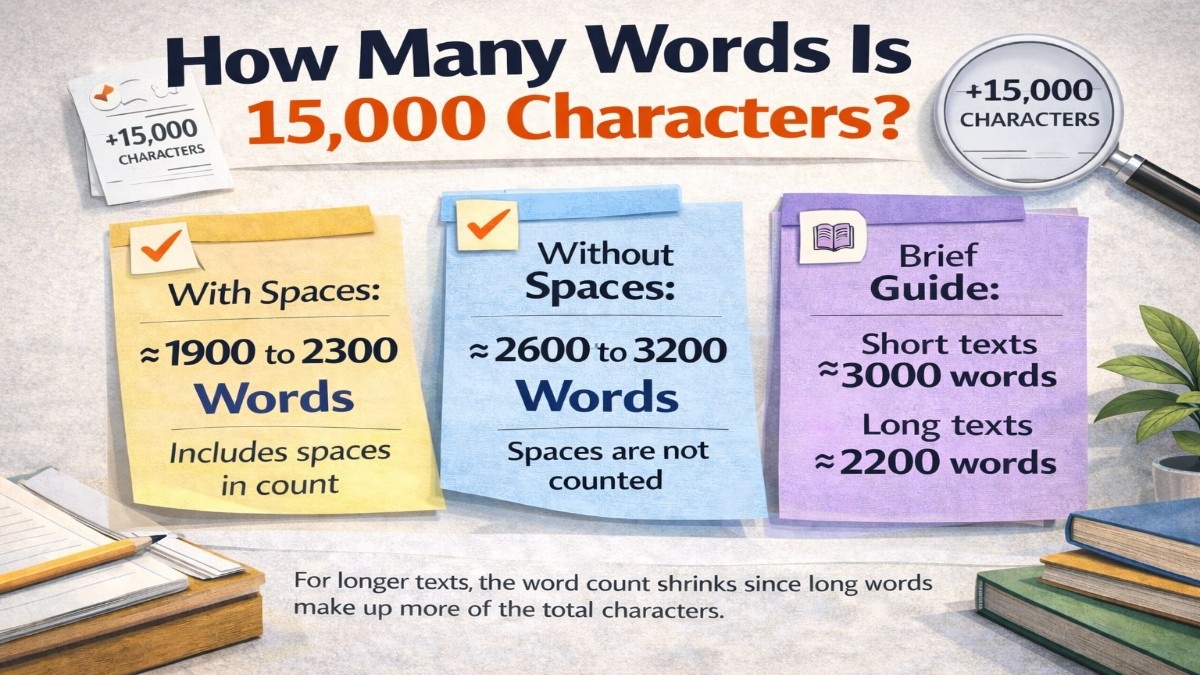
Answer: 15,000 characters equals approximately 2,400 to 2,650 words when spaces are counted — the default for virtually every word processor, publishing platform, and developer API. Strip the spaces and that same 15,000 characters stretches to roughly 3,000 to 3,200 words. Either way, you are looking at a substantial long-form article, a detailed research essay, or a thorough technical deep-dive.
That is the quick answer. But if you are submitting to a journal with a strict character cap, planning an SEO content calendar, or architecting a product that enforces field limits — the details matter. This guide covers every angle with real examples, a full conversion table, platform-specific limits, and actionable writing tips you can use immediately.
📊 Quick Reference: 15,000 Characters at a Glance
- 15,000 characters with spaces: ~2,400–2,650 words
- 15,000 characters without spaces: ~3,000–3,200 words
- Estimated reading time: ~10–13 minutes (at 200–250 wpm)
- Equivalent page count: ~9–10 pages (double-spaced, 12pt Times New Roman)
- Single-spaced page count: ~4.5–5 pages (12pt Times New Roman, 1-inch margins)
- Typical use case: Long-form blog post, in-depth research essay, technical white paper, or a detailed product guide
Why Is Character Count Different From Word Count?
A character is every individual symbol — each letter, space, comma, period, or digit. A word is a cluster of characters separated by whitespace. The entire gap between these two measurements comes down to one variable: average word length in your text.
According to Oxford English Dictionary corpus data, the average English word is 4.7 characters long. Add the single space that follows each word and that rises to 5.7 characters per word. Divide 15,000 by 5.7 and you get approximately 2,632 words — which is why "roughly 2,500 words" is the reliable working estimate most professionals use for 15,000 characters.
Here is the formula that drives every estimate in this article:
Words ≈ Characters (with spaces) ÷ 5.7
Words ≈ Characters (without spaces) ÷ 4.7
15,000 ÷ 5.7 ≈ 2,632 words | 15,000 ÷ 4.7 ≈ 3,191 words
The range 2,400–3,200 accounts for natural writing variation. Legal, academic, and technical texts use longer polysyllabic terms — "epistemological," "immunosuppressant," "counterproductive" — that consume 12–18 characters each. More characters per word means fewer total words for the same budget. Conversational blog posts and news copy use shorter, punchier words, pushing the count higher.
Does Your Writing Style Affect the Word Count for 15,000 Characters?
Absolutely — and the swing can exceed 400 words between two documents of identical character length. It is one of the most overlooked facts in content planning, and it matters more than most writers realize.
Academic and scientific writing leans on polysyllabic terminology. A single word like "photosynthesis" (14 characters) or "macroeconomics" (15 characters) uses the same space as three common words combined. At this scale, that difference compounds quickly across thousands of words.
Conversational writing — lifestyle blogs, newsletters, social captions — relies on compact words like "big," "fast," "now," and "get." More short words per line means a higher word count for the same character budget. A legal brief and a food blog can differ by 300–400 words while containing the exact same number of characters.
Punctuation adds characters without adding words. Heavy use of em dashes — like this one — semicolons; parentheses (used liberally); and quotation marks all increase your character count silently. A novelist and a data scientist writing the same word count can produce noticeably different character totals for this reason alone.
Character-to-Word Conversion Table (Bookmark This)
Use this reference table for quick estimates across common character counts. All figures use the English average of 5–6 characters per word with spaces included. For an exact count on your actual text, paste it directly into the free word and character counter at WordCounter.vip — it calculates word count, character count (with and without spaces), reading time, and readability score in real time, with no login required.
| Characters | Words | Time |
|---|---|---|
| 85 | ~10–15 | ~5 sec |
| 350 | ~50–70 | ~20 sec |
| 500 | ~80–100 | ~30 sec |
| 600 | ~90–110 | ~30 sec |
| 700 | ~110–130 | ~40 sec |
| 750 | ~120–140 | ~45 sec |
| 800 | ~130–150 | ~45 sec |
| 900 | ~140–160 | ~50 sec |
| 1,000 | ~150–175 | ~1 min |
| 1,200 | ~180–210 | ~1 min |
| 1,250 | ~190–220 | ~1–1.5 min |
| 1,300 | ~200–230 | ~1–1.5 min |
| 1,600 | ~250–280 | ~1–2 min |
| 2,000 | ~300–350 | ~1.5 min |
| 2,048 | ~300–360 | ~2 min |
| 2,400 | ~380–420 | ~2 min |
| 2,600 | ~400–450 | ~2–3 min |
| 3,000 | ~450–525 | ~2–3 min |
| 3,200 | ~500–560 | ~3 min |
| 3,500 | ~550–620 | ~3 min |
| 3,600 | ~560–630 | ~3–4 min |
| 3,900 | ~600–680 | ~4 min |
| 4,000 | ~600–700 | ~3 min |
| 4,096 | ~650–720 | ~4 min |
| 5,000 | ~750–880 | ~3–4 min |
| 6,000 | ~900–1,050 | ~4–5 min |
| 6,500 | ~1,000–1,120 | ~5 min |
| 7,000 | ~1,100–1,250 | ~5–6 min |
| 7,500 | ~1,150–1,300 | ~6 min |
| 8,000 | ~1,250–1,400 | ~6 min |
| 9,000 | ~1,400–1,600 | ~7 min |
| 9,600 | ~1,500–1,700 | ~7–8 min |
| 10,000 | ~1,500–1,750 | ~7–8 min |
| 15,000 | ~2,400–2,650 | ~10–12 min ← you are here |
| 20,000 | ~3,200–3,600 | ~14–16 min |
| 30,000 | ~4,800–5,400 | ~20–25 min |
| 32,000 | ~5,000–5,800 | ~25 min |
| 50,000 | ~8,000–9,000 | ~40–45 min |
| 60,000 | ~9,500–10,800 | ~50–55 min |
| 70,000 | ~11,000–12,500 | ~60+ min |
| 100,000 | ~16,000–18,000 | ~80–90 min |
* Reading time: ~10–12 min (200–250 WPM average speed)
How Many Pages Is 15,000 Characters?
With approximately 2,400–2,650 words, 15,000 characters translates to roughly 9–10 double-spaced pages or 4.5–5 single-spaced pages using Times New Roman 12pt with standard 1-inch margins — the default setup for most academic and professional documents worldwide.
Font choice shifts the page count more than most writers expect. Times New Roman is notably condensed compared to Arial or Calibri — it fits roughly 10% more characters per line. The same 15,000 characters will occupy slightly more pages in Calibri 12pt than in Times New Roman 12pt. Line spacing, margin width, and paragraph indentation amplify this difference further.
A quick rule of thumb: a standard A4 page with single spacing holds around 3,000–3,500 characters. So 15,000 characters equals roughly 4–5 single-spaced A4 pages, or 8–10 pages when double-spaced. For US Letter paper, the numbers are nearly identical given the similar printable area.
💡 Need an exact page count for your formatting?
The words-per-page calculator at WordCounter.vip lets you enter your font family, size, line spacing, page size, and margin settings to get a tailored estimate. It covers A4, US Letter, APA, MLA, Chicago, and custom formats.
Where Do 15,000-Character Limits Actually Appear in Real Life?
Character limits appear across social platforms, academic submission portals, developer APIs, and publishing tools. Knowing that 15,000 characters is roughly 2,500 words helps you plan content that fits without last-minute trimming — or embarrassing overflows.
Social Media and Content Platforms
- LinkedIn Articles: Support up to 125,000 characters, making 15,000 characters a focused, mid-length LinkedIn article. LinkedIn's own research indicates that articles between 1,500 and 2,500 words generate the strongest professional engagement — right in the 15,000-character zone.
- Medium: Has no hard character limit, but Medium's internal data has consistently shown articles between 1,800 and 3,000 words reach the highest reader completion rates. At ~2,500 words, 15,000 characters sits comfortably in that performance window.
- Substack: Also has no enforced character cap, but the platform's analytics favour newsletter posts between 1,500 and 3,000 words — again aligning directly with 15,000 characters.
- YouTube Video Descriptions: Are capped at 5,000 characters — so 15,000 characters is 3× the YouTube description limit. Only the first ~100 characters appear in search result previews.
SEO and Web Content Strategy
- Competitive long-form content: SEO research from Ahrefs found that the top-ranking pages for informational queries average 1,400 to 1,800 words. At ~2,500 words, 15,000 characters exceeds that average — making it well-positioned for competitive, high-search-volume topics that reward depth.
- Pillar pages and content hubs: HubSpot's content strategy research identifies pillar pages as the backbone of topic cluster SEO. These cornerstone articles typically run 2,000–4,000 words, placing 15,000 characters in an ideal range for this format.
- Google meta descriptions: Capped at 155–160 characters. Fifteen thousand characters is nearly 94× the length of a single meta description — a useful reminder that different surfaces have wildly different character constraints.
Academic and Professional Writing
- Undergraduate research papers: Most university departments assign short research papers at 2,000–2,500 words — which maps precisely to the 15,000-character range. This is the length many undergraduates write most frequently throughout their degree.
- Journal article abstracts: Most peer-reviewed journals limit abstracts to 200–300 words (~1,200–1,800 characters). A 15,000-character abstract would be rejected by every major journal without question — another reminder that context defines appropriateness.
- Business white papers and case studies: Industry standard white papers typically run 2,000–3,000 words. At ~2,500 words, 15,000 characters is a natural fit for this format when written in clear, direct business English.
- IELTS Writing Task 2: Requires a minimum of 250 words, with top-scoring responses averaging 280–320 words (~1,700–2,000 characters). Fifteen thousand characters is roughly 8× the ideal response length — well over the mark for that specific task.
Is 15,000 Characters Enough for Competitive SEO Content?
At roughly 2,400–2,650 words, 15,000 characters positions you very competitively across most informational, educational, and commercial search queries. This length comfortably exceeds the median word count of top-ranking pages for the vast majority of topics.
HubSpot's content research found that articles between 2,250 and 2,500 words drive the most organic traffic on average across industries. Fifteen thousand characters lands squarely in that zone. For competitive topics with high-authority competition, going deeper — to 3,000–4,000 words — may be warranted, but for most queries, 15,000 characters is more than sufficient.
Google's Helpful Content system — updated and reinforced through 2023 and 2024 — rewards depth and accuracy over raw volume. A clear, well-researched 2,000-word article regularly outranks a bloated 5,000-word piece padded with repetition. Intent match, E-E-A-T signals, and topical authority outweigh character count every single time.
For AI-powered search surfaces like Google AI Overviews, Perplexity, and ChatGPT Search, answer-first structure and factual density matter more than total length. Lead with your conclusion in the first paragraph, support it with evidence, and use structured subheadings that mirror real user questions. Sources that answer queries directly and specifically are far more likely to be cited in AI-generated summaries.
📌 SEO Tip for Content Teams: Before deciding whether 15,000 characters is enough for your target keyword, benchmark the top-5 competing pages. The website word count tool at WordCounter.vip lets you count total words on any live URL instantly — no browser extension or manual copy-paste needed.
How Does 15,000 Characters Compare to Common Content Lengths?
Context makes the number meaningful. Here is where 15,000 characters sits relative to the limits writers encounter every day:
- 📱 Twitter / X post: 280 characters (~50 words)
- 📸 Instagram caption limit: 2,200 characters (~370 words)
- 💼 LinkedIn post limit: 3,000 characters (~500 words)
- ✉️ Average marketing email body: 3,000–4,000 characters (~500–700 words)
- 📺 YouTube description limit: 5,000 characters (~830 words)
- 📝 15,000 characters: ~2,400–2,650 words — a complete long-form article
- 📖 Average published novel chapter: 15,000–30,000 characters (~2,500–5,000 words)
- 📗 Full novel (standard): 420,000–600,000 characters (~70,000–100,000 words)
By that comparison, 15,000 characters is genuinely substantial for digital content. It is 5× the maximum LinkedIn post length, 53× the length of a tweet, and 3× the entire YouTube description allowance. Interestingly, it sits right at the bottom of a typical published novel chapter — which makes it a complete, self-contained unit of storytelling or argumentation in any genre.
For practical purposes, 15,000 characters is enough to introduce a complex topic thoroughly, develop it with multiple angles, address objections, include real data, and land a conclusion that earns the reader's trust. That is what separates a 2,500-word article from a 500-word summary — not length for its own sake, but the ability to go where shallow content cannot.
6 Practical Tips for Writing Within a 15,000-Character Budget
A defined character budget forces precision — and that is actually a strategic advantage. Here is how to make every character earn its place, whether you are filling the budget or trying to stay under a platform cap:
- Lead with your answer, not your warm-up. Do not spend three sentences building to the point. State the key fact or conclusion in your opening line. Google's Quality Rater Guidelines explicitly cite "answer-first" structure as a signal of helpful, trustworthy content — and AI search engines reward it even more directly.
- Keep sentences under 20 words. Flesch-Kincaid readability research shows that sentences under 20 words significantly improve comprehension for general audiences. Shorter sentences also use fewer characters per idea — a double win inside any character limit.
- Eliminate redundant phrases ruthlessly. "In order to" → "to." "Due to the fact that" → "because." "At this point in time" → "now." Each swap saves 5–15 characters and sharpens your prose without losing any meaning whatsoever.
- Use numerals instead of spelled-out numbers. "15,000" uses 6 characters; "fifteen thousand" uses 15. In data-heavy or technical writing, numerals win consistently — and they are easier to scan at a glance, which improves readability metrics too.
- Audit every adjective before you publish. Remove any modifier that adds no new information beyond its noun. You will trim characters and tighten copy simultaneously — two improvements for zero additional effort.
- Use subheadings as navigation, not decoration. At 2,500 words, readers will skim before they commit to reading in full. Descriptive, question-based H2 and H3 headings let readers jump to the exact section they need — which reduces bounce rate and signals strong UX to Google.
Frequently Asked Questions
Is 15,000 characters a lot of text?
It depends on context. For a tweet, 15,000 characters is enormous — about 53 full posts. For a research dissertation or a novel, it is a single chapter. For a long-form blog post, a white paper, or a detailed university assignment, it is a complete and satisfying length that gives you room to genuinely develop an argument from premise to conclusion.
How long does it take to write 15,000 characters?
For an experienced writer, 15,000 characters — roughly 2,400–2,650 words — takes about 1.5–3 hours to draft and 45–60 minutes to edit. Research-heavy or technical topics can push the total time to 5–8 hours from initial outline to polished final copy. First drafts are always faster than their revision cycles.
Does 15,000 characters include spaces?
It depends on the platform or tool. Most text editors, word processors, and social media platforms include spaces in character counts by default. Always check the documentation when a platform enforces a hard character limit — the difference between "with spaces" and "without spaces" can represent 300–500 words at this scale, which is a significant gap.
How many paragraphs is 15,000 characters?
Assuming standard paragraphs of 100–150 words (600–900 characters each), 15,000 characters equals approximately 18–25 paragraphs. In web writing, where shorter 2–4 sentence paragraphs are preferred for mobile readability, the same content may span 30–40 paragraphs — which is why digital content often looks longer on screen than it reads in terms of pure word count.
How many sentences is 15,000 characters?
An average English sentence runs 15–20 words, or roughly 90–120 characters with punctuation and trailing space included. That puts 15,000 characters at approximately 125–165 sentences. The exact count shifts depending on how long your sentences run in practice — technical writing tends to run longer; journalistic writing tends to run shorter.
How many words is 15,000 characters in other languages?
English estimates rely on a 4.7-character average word length. Other languages differ meaningfully: German words average 5.3 characters (compound nouns inflate the count significantly), while Spanish averages 4.4 characters and French averages around 4.5. A Spanish writer will extract more words from 15,000 characters than a German writer will. Logographic languages like Chinese and Japanese have entirely different counting conventions — always verify with a dedicated tool rather than applying English-based estimates.
How long does it take to read 15,000 characters?
At an average adult reading speed of 200–250 words per minute — the figure cited in research published in Psychological Science in the Public Interest — 15,000 characters (~2,400–2,650 words) takes approximately 10–13 minutes to read. Factoring in natural pauses, re-reading complex sections, and reviewing any data or tables, real-world reading time is closer to 12–15 minutes for most audiences.
Final Answer: How Many Words Is 15,000 Characters?
The verified, direct answer: 15,000 characters equals approximately 2,400 to 2,650 words when spaces are included, or up to 3,000–3,200 words when spaces are excluded. The estimate uses the Oxford English Dictionary corpus average of 4.7 characters per English word, rising to 5.7 characters when the trailing space is included — the same calculation that underpins every major word processing tool from Microsoft Word to Google Docs.
For most practical purposes — planning a long-form blog post, meeting a university word count requirement, scoping a white paper, or estimating reading time for your audience — treating 15,000 characters as roughly 2,500 words is accurate and reliable. For an exact count on your specific text, always use a dedicated tool rather than estimating manually, since writing style alone can shift the count by 200–400 words in either direction.
And remember: character count is a measurement tool, not a quality signal. A well-structured, factually accurate 2,000-word article will consistently outperform a padded, repetitive 4,000-word piece in Google Search, in AI-generated summaries, and — most importantly — in the minds of real readers. Write with precision and purpose, and the count will take care of itself.
BLOG
How Many Words Per Page
by Raviraj Bhosale
Discover how many words fit on a page. Learn word counts for double spaced, single spaced, and handwritten pages with real examples.
BLOG
How Many Words Is 7000 Characters
by Raviraj Bhosale
7,000 characters equals approximately 1,100 to 1,250 words with spaces included. Learn how formatting, writing style, and platform rules shift that estimate for your specific use case.
BLOG
How Many Words Is 6000 Characters
by Raviraj Bhosale
6,000 characters equals approximately 900 to 1,050 words with spaces included. Learn how formatting, writing style, and platform rules shift that estimate for your specific use case.