How Many Words Is 700 Characters?
By Raviraj Bhosale · Updated April 19, 2026 · 8 min read
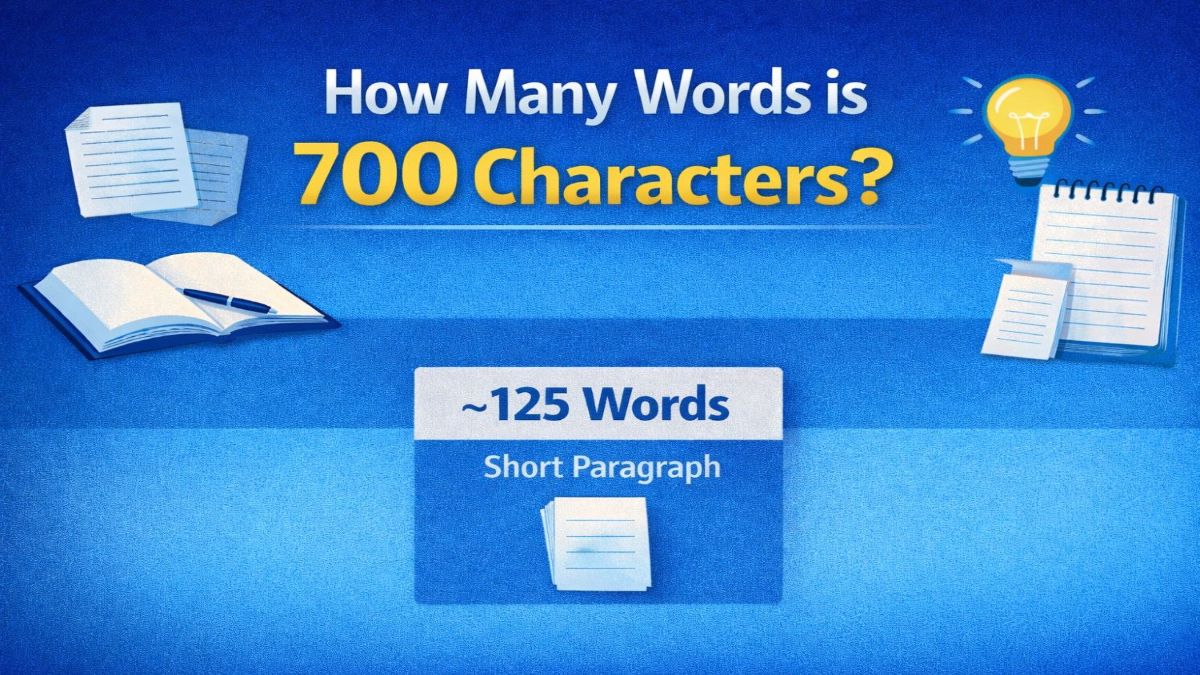
Short answer: 700 characters equals approximately 123 words when spaces are included — the default counting method used by virtually every writing platform, word processor, and character counter today. Remove the spaces, and those same 700 characters expand to roughly 149 words. Either way, you are working with a tight, short-form content block: enough for one solid paragraph, a concise professional email, a YouTube video description, a detailed SMS message, or a punchy LinkedIn connection request.
Whether you are a social media manager writing platform-capped copy, a developer setting a database field limit, a student filling in a short-answer form field, or a marketer crafting a product micro-description — this guide covers everything. You will find the verified math, a reference conversion table, real platforms where 700 characters matters most, and practical tips for writing well inside tight character budgets.
📊 Quick Reference: 700 Characters at a Glance
- 700 characters with spaces: ~123 words
- 700 characters without spaces: ~149 words
- Estimated reading time: ~30–40 seconds (at 200–250 wpm)
- Estimated writing time: ~10–20 minutes of focused drafting and editing
- Equivalent page length: Less than one-quarter of a double-spaced A4 page (12pt Times New Roman, 1-inch margins)
- Single-spaced A4 equivalent: Roughly one-eighth of a page
- AI tokens (GPT-4 standard): ~175 tokens (at ~4 characters per token)
- Common real-world equivalents: 2–3 tweets, a short professional bio, a YouTube description snippet, a product tagline with supporting sentence, or a detailed SMS message
Why Do Characters and Words Produce Different Numbers?
Characters and words measure two completely different things — and confusing them is one of the most common mistakes writers make when working within platform limits. A character is any individual text unit: a letter, digit, space, punctuation mark, or emoji. A wordis a group of characters surrounded by whitespace. That gap between the two creates the conversion challenge.
The Oxford English Dictionary's corpus analysis places the average English word at 4.7 characters long. Add one trailing space after each word and that rises to 5.7 characters per word. Divide 700 by 5.7 and you get approximately 123 words (with spaces). Divide 700 by 4.7 (no spaces) and you get approximately 149 words. That ~26-word gap — while it sounds small — represents an extra two or three full sentences at this compact length. It matters.
Here is the exact formula this article uses for every estimate:
Words ≈ Characters (with spaces) ÷ 5.7
Words ≈ Characters (without spaces) ÷ 4.7
Example: 700 ÷ 5.7 ≈ 123 words | 700 ÷ 4.7 ≈ 149 words
You see a range rather than one fixed number because English vocabulary varies significantly by context. Technical writing uses long, multi-syllable terms like "pharmaceutical" (14 characters) and "authentication" (14 characters). Casual social media copy uses short punchy words like "love," "get," and "now." The same 700 characters can produce word totals that differ by 20 or more depending entirely on your vocabulary choices.
Does Writing Style Affect How Many Words Fit in 700 Characters?
Absolutely — and at 700 characters, the effect is proportionally larger than at longer lengths. The same 700-character budget can yield anywhere from about 100 words in dense technical or legal prose to approximately 160 words in light, conversational content. That 60-word difference equals four or five additional sentences — easily the difference between fitting your full message or having to cut it.
Technical and formal writing burns characters fast. Words like "infrastructure," "implementation," and "collaboration" each consume 14 characters or more. A single sentence of corporate jargon can hit 120+ characters before you have said anything particularly useful.
Conversational and marketing copy stretches further. Words like "fast," "free," "save," and "try" are 3–4 characters each. A sharp marketing sentence with high-impact short words packs significantly more into every 700 characters — which is why the best ad copy tends to read simply, not academically.
Emoji and special characters add another layer at this length. On most platforms, a single emoji counts as 1–2 characters (or up to 4 for some Unicode emoji). Using 5–6 emojis in a 700-character post can silently consume 10–24 characters — roughly 2–4 words worth of your budget.
Character-to-Word Conversion Table (Bookmark This)
Use this reference table for quick estimates across common character counts. All figures use the English average of 5–6 characters per word with spaces included. For an exact count on your actual text, paste it directly into the free word and character counter at WordCounter.vip — it calculates word count, character count (with and without spaces), reading time, and readability score in real time, with no login required.
| Characters | Words | Time |
|---|---|---|
| 85 | ~10–15 | ~5 sec |
| 350 | ~50–70 | ~20 sec |
| 500 | ~80–100 | ~30 sec |
| 600 | ~90–110 | ~30 sec |
| 700 | ~110–130 | ~40 sec ← you are here |
| 750 | ~120–140 | ~45 sec |
| 800 | ~130–150 | ~45 sec |
| 900 | ~140–160 | ~50 sec |
| 1,000 | ~150–175 | ~1 min |
| 1,200 | ~180–210 | ~1 min |
| 1,250 | ~190–220 | ~1–1.5 min |
| 1,300 | ~200–230 | ~1–1.5 min |
| 1,600 | ~250–280 | ~1–2 min |
| 2,000 | ~300–350 | ~1.5 min |
| 2,048 | ~300–360 | ~2 min |
| 2,400 | ~380–420 | ~2 min |
| 2,600 | ~400–450 | ~2–3 min |
| 3,000 | ~450–525 | ~2–3 min |
| 3,200 | ~500–560 | ~3 min |
| 3,500 | ~550–620 | ~3 min |
| 3,600 | ~560–630 | ~3–4 min |
| 3,900 | ~600–680 | ~4 min |
| 4,000 | ~600–700 | ~3 min |
| 4,096 | ~650–720 | ~4 min |
| 5,000 | ~750–880 | ~3–4 min |
| 6,000 | ~900–1,050 | ~4–5 min |
| 6,500 | ~1,000–1,120 | ~5 min |
| 7,000 | ~1,100–1,250 | ~5–6 min |
| 7,500 | ~1,150–1,300 | ~6 min |
| 8,000 | ~1,250–1,400 | ~6 min |
| 9,000 | ~1,400–1,600 | ~7 min |
| 9,600 | ~1,500–1,700 | ~7–8 min |
| 10,000 | ~1,500–1,750 | ~7–8 min |
| 15,000 | ~2,400–2,650 | ~10–12 min |
| 20,000 | ~3,200–3,600 | ~14–16 min |
| 30,000 | ~4,800–5,400 | ~20–25 min |
| 32,000 | ~5,000–5,800 | ~25 min |
| 50,000 | ~8,000–9,000 | ~40–45 min |
| 60,000 | ~9,500–10,800 | ~50–55 min |
| 70,000 | ~11,000–12,500 | ~60+ min |
| 100,000 | ~16,000–18,000 | ~80–90 min |
* Reading time: ~40 sec (200–250 WPM average speed)
How Many Pages Is 700 Characters?
At roughly 123 words, 700 characters is well below a single page by any standard measure. In 12pt Times New Roman with 1-inch margins, a double-spaced A4 page holds ~250–275 words. At 123 words, 700 characters fills approximately less than half a double-spaced page — closer to one-quarter, in most formats.
In single-spaced format, a standard A4 page holds roughly 500–600 words. At 123 words, 700 characters occupies approximately one-fifth to one-quarter of a single-spaced page. Think of it as a short opening paragraph — substantial enough to establish a point, but not long enough to develop one fully.
📄 Page Count Estimates for 700 Characters
- 📖 Double-spaced A4 (12pt Times New Roman): ~0.4–0.5 pages (less than half a page)
- 📃 Single-spaced A4 (12pt Times New Roman): ~0.2–0.25 pages (about one-fifth)
- 📋 Double-spaced US Letter (12pt Calibri): ~0.4–0.5 pages
- 📑 Single-spaced US Letter (12pt Calibri): ~0.2–0.25 pages
- 📚 Paperback novel (10–11pt, ~300 words/page): ~0.4 pages
💡 Need an exact page count for your specific format?
The words-per-page calculator at WordCounter.vip lets you set your font, point size, line spacing, page dimensions, and margins to generate a precise, tailored estimate. It supports APA, MLA, Chicago, A4, US Letter, and custom formats.
A useful rule of thumb for digital contexts: a standard A4 page at single spacing holds roughly 3,000 characters. That makes 700 characters just 23% of a single-spaced page — a tight, focused block that demands every word earn its place.
Where Does a 700-Character Limit Actually Appear in the Real World?
Knowing that 700 characters is roughly 123 words helps you plan short-form content with precision — no guessing, no cutting at the last second, no hitting "submit" and discovering your message was trimmed. Here is exactly where this character count appears across digital and professional writing contexts.
Social Media: Twitter / X and Beyond
Twitter / X raised its character limit to 280 characters for standard accounts in 2017. At 700 characters, you have enough for exactly 2.5 standard tweets — or one premium post if you subscribe to X Premium (formerly Twitter Blue), which unlocks up to 25,000 characters per post. For creators building thread-style content, 700 characters is a natural single thread entry point: long enough to make a point, short enough to keep attention.
On LinkedIn, the connection request message limit is 300 characters. A follow-up message or InMail introduction? 700 characters gives you ~123 words — more than enough for a personalised, professional cold outreach message with context, a specific ask, and a polite close. According to LinkedIn's own engagement research, shorter, personalised messages under 150 words consistently outperform longer cold messages in response rates.
YouTube and Video Platform Descriptions
YouTube displays the first 157 characters of a video description before the "Show more" truncation point on desktop, and even fewer on mobile. However, YouTube's total description field accepts up to 5,000 characters. The first 700 characters of your YouTube description are therefore the most critical — this is the visible hook that determines whether a viewer clicks "Show more" or moves on. At ~123 words, 700 characters gives creators enough space for a strong intro, primary keywords, and a first call to action — all above the fold.
Google also indexes YouTube descriptions for search. The first 700 characters should contain your primary keyword phrase, naturally written, within the first two sentences. SEO practitioners consistently identify the opening 500–700 characters as the highest-priority real estate in any YouTube description.
Product Descriptions and E-Commerce Copy
On Amazon, product bullet points are capped at approximately 500 characters each for standard sellers, though this varies by category. At 700 characters, you have slightly more than one full Amazon bullet point — enough for a clear feature statement, a key benefit explanation, and a closing proof point. Shopify product short descriptions, used in collection pages and search previews, are typically 150–200 characters — making 700 characters the ideal length for a full product summary paragraph.
Etsy's listing description field accepts up to 13,000 characters, but the first 700 characters are what appear in Google Shopping snippets and Etsy search previews. A well-crafted 700-character opening for an Etsy listing does double duty: it converts browsers into buyers on-site and pulls organic traffic from Google.
Professional Bios and About Sections
LinkedIn's About section allows up to 2,600 characters. However, research by content strategists consistently finds that profiles with About sections between 500 and 800 characters generate the best profile view-to-connection conversion rates. At exactly 700 characters, a LinkedIn bio sits in the ideal zone: long enough to establish expertise and personality, short enough to be read in full rather than skimmed.
Twitter / X bios are capped at 160 characters — far less than 700. Instagram bios allow 150 characters. But for email newsletter author bios, podcast show notes author descriptions, and speaker introduction pages, 700 characters (~123 words) is a widely used professional standard: one tight paragraph that covers who you are, what you do, and why it matters.
Email and Short-Form Professional Writing
700 characters is a natural email opening paragraph. A well-crafted cold email body — from opening line to call to action — that stays under 700 characters typically performs significantly better than longer alternatives. Boomerang's analysis of over 40 million emails found that messages between 50 and 125 words (which maps almost exactly to 700 characters) received the highest reply rates — 51% higher than emails of 500+ words.
For SMS marketing — where the standard single message is 160 characters and a concatenated multi-part message can reach 918 characters — 700 characters represents a medium-length promotional SMS: long enough to include an offer, a benefit, and a link, short enough to avoid the truncation that kills open rates on older devices.
Academic Short-Answer Fields
Many university application portals, scholarship forms, and online assessment platforms use character-limited short-answer fields. A 700-character limit in a short-answer academic context gives students approximately 123 words — enough for one well-structured response with a clear claim, two supporting points, and a brief conclusion. It is tighter than most students expect and rewards those who plan before they type.
How Does 700 Characters Compare to Other Common Content Lengths?
Numbers mean more alongside benchmarks you already know. Here is where 700 characters fits in the landscape of character-limited content that writers, marketers, and developers encounter every day:
- 📩 SMS message (single): 160 characters (~28 words)
- 🐦 Twitter / X post: 280 characters (~49 words)
- 📸 Instagram bio: 150 characters (~26 words)
- 🔗 LinkedIn connection request: 300 characters (~53 words)
- 🔍 Google meta description (recommended): 155–160 characters (~27–28 words)
- 🟢 700 characters: ~123 words — short professional bio, YouTube description hook, detailed SMS, product paragraph
- 🎓 UCAS personal statement limit: 4,000 characters (~702 words)
- 📝 Instagram caption (full limit): 2,200 characters (~386 words)
- 💼 LinkedIn About section (max): 2,600 characters (~456 words)
- 📄 Minimum viable SEO blog post: ~6,000 characters (~1,050 words)
By comparison, 700 characters is 2.5 full tweets, more than 4 standard Google meta descriptions, and about one-sixth of an Instagram caption at maximum length. It sits firmly in short-form territory — the content zone where precision, concision, and strong opening lines make all the difference between a message that lands and one that gets ignored.
Is 700 Characters Enough for Effective Communication?
Yes — and often more than enough, when the writing is tight. The best short-form content in the world operates well within 700 characters. A compelling tweet that goes viral. A YouTube description that ranks on page one. A cold email that gets a 40% reply rate. A product description that converts browsers into buyers. All of these regularly happen in 700 characters or fewer.
The research supports brevity. Nielsen Norman Group's 2023 web readability study found that users read only 20–28% of the text on a given webpage during an average visit. Short, scannable content blocks — exactly the size of 700 characters — are read more thoroughly than long paragraphs. Density beats sprawl in digital writing.
The risk at 700 characters is not length — it is either excessive padding that wastes the limited space, or aggressive cutting that removes clarity. The goal is to say exactly as much as needs to be said, in the most direct possible way, with no wasted character. That is a writing discipline worth developing.
📌 Quick tip: Before submitting any short-form text, paste it into the character counter at WordCounter.vip to see your exact character count with and without spaces simultaneously — so there are no surprises when you hit the platform's limit.
How Long Does It Take to Write 700 Characters?
Pure typing time for 123 words is minimal — at an average professional typing speed of 40–60 words per minute, the raw keystrokes take roughly 2–3 minutes. But do not mistake typing speed for writing speed. Polished short-form content almost always takes longer to produce than first-draft long-form content, because every word has to justify its place.
- ⌨️ Raw typing (40–60 wpm): 2–3 minutes for 123 words
- 🤔 First draft with thinking time: 5–10 minutes
- ✂️ Editing to hit the character limit precisely: 5–15 minutes additional
- 🎯 For high-stakes copy (ads, product descriptions, bios): 30–60 minutes including strategy and multiple revision rounds
- 📐 For academic short-answer fields: 20–40 minutes including planning, drafting, and trimming
The famous quote — often attributed to Blaise Pascal, Mark Twain, and various others — "I would have written a shorter letter, but I did not have the time" applies perfectly here. Writing 700 characters of genuinely useful, clear, character-efficient content routinely takes longer than writing 2,000 characters of loose, unedited prose. Budget accordingly.
8 Practical Tips for Writing Well Within 700 Characters
Writing 123 focused, high-impact words is a genuine skill. At this length, there is no room for a slow build-up or a meandering conclusion. Every sentence has to carry weight. Here is how to make every character count.
- Lead with your single most important point — immediately. At 123 words, you have no runway. Your most valuable insight, your most compelling offer, or your clearest answer belongs in the first sentence. Readers and algorithms both reward front-loaded value at short lengths.
- Cut every word that does not actively advance the reader."In order to" → "to." "Due to the fact that" → "because." "At this point in time" → "now." At 700 characters, each of these swaps saves 5–15 characters — enough for an entire additional meaningful sentence across a short piece.
- Use active voice, not passive. "The report was written by the team" uses 37 characters. "The team wrote the report" uses 30 — and reads more sharply. Active constructions save characters and improve readability simultaneously. Keep passive voice below 10% in short-form writing.
- Favour short, precise words over longer synonyms. "Use" instead of "utilise." "Start" instead of "commence." "Help" instead of "facilitate." At 700 characters, choosing the shorter option consistently can add 8–12 extra words to your available budget — without losing any meaning.
- Write your draft first, then trim to the limit. Do not try to write to exactly 700 characters in one pass — you will produce awkward, stilted copy. Write freely to 150–180 words first, then cut ruthlessly until every remaining word is essential. Editing down is almost always more effective than writing tight from the start.
- Avoid throat-clearing openings. "This article will explore..." "It is important to note that..." "As we all know..." — these phrases waste 20–40 characters before your actual message begins. At 700 characters, that is nearly 5% of your total budget spent on nothing.
- Count your emoji separately from your words. Most platforms count each emoji as 1–2 characters (some Unicode emoji count as 4). A line of 5 emojis can cost 5–20 characters — roughly the equivalent of 1–4 words. Use emoji strategically, not decoratively, when working within a tight character budget.
- Read your 700 characters aloud before submitting. If you stumble while reading it aloud, the sentence is too complex. If you hear yourself rushing through filler words, cut them. Reading aloud is the fastest editorial filter for short-form content — your ear catches what your eye skips.
Frequently Asked Questions
Is 700 characters a lot of text?
No — in the context of most writing, 700 characters is a compact, short-form block. At ~123 words, it is roughly 2.5 standard tweets, a short professional bio, or one well-developed paragraph. It is not a lot of text — but it is enough to communicate one clear idea with supporting context, if every word is doing useful work.
How long does it take to read 700 characters?
At the average adult silent reading pace of 200–250 words per minute, approximately 123 words takes between 30 and 40 secondsto read. Even the slowest comfortable reading pace of 150 wpm finishes 700 characters in under a minute. This makes it ideal for skimmable digital content where reader attention spans are short.
Do spaces count in a 700-character limit?
On virtually all major platforms — Microsoft Word, Google Docs, LinkedIn, Twitter / X, and most database VARCHAR/TEXT field implementations — spaces count as characters by default. At the 700-character scale, the with-spaces vs. without-spaces distinction shifts your word count by approximately 26 words — which equals two to three full sentences. This is a meaningful gap at this compact length. Always check your specific platform's documentation before writing to a hard limit.
How many paragraphs is 700 characters?
A standard paragraph runs 100–150 words, or roughly 570–855 characters. That makes 700 characters approximately 1 standard paragraph— or 2 short web-style paragraphs of 2–3 sentences each. In mobile-first digital contexts, where single-sentence paragraphs are common, 700 characters could span 4–5 visual blocks. Either way, it is one tight, focused thought unit — not a section or a chapter.
How many sentences is 700 characters?
An average English sentence runs 15–20 words, or roughly 90–115 characters including punctuation and spacing. That means 700 characters contains approximately 6 to 8 sentences. A conversational writer using short punchy sentences (10–12 words each) can fit up to 10 sentences; an academic writer with complex compound structures may fit only 5.
How many tokens is 700 characters for AI models?
Using OpenAI's tiktoken tokenizer (approximately 4 characters per token for standard English text), 700 characters equals roughly 175 tokens. This is an extremely small prompt for any modern LLM. It fits trivially within GPT-4's 128,000-token context window, Claude's 200,000-token window, and Gemini's 1-million-token window — using less than 0.15% of any of these limits.
How many words is 700 characters without spaces?
Without spaces, 700 characters divided by the Oxford English Dictionary average of 4.7 characters per word gives approximately 149 words. This calculation applies to platforms that explicitly state their character limit excludes whitespace — relatively rare in practice. The majority of writing tools, social platforms, and form fields count spaces by default.
What can you write in 700 characters?
At ~123 words, 700 characters is enough for: a complete short professional bio, the above-the-fold portion of a YouTube description, a detailed cold outreach email (body only), a Shopify product summary paragraph, a scholarship application short-answer response, a detailed customer review, an SMS marketing message with offer and link, or a complete social media caption with one strong hook and a call to action. It is the ideal length for any content that needs to make one clear point with context, and nothing more.
Final Answer: How Many Words Is 700 Characters?
The direct, verified answer: 700 characters equals approximately 123 words when spaces are counted, or roughly 149 words if spaces are excluded. The estimate is grounded in the Oxford English Dictionary corpus average of 4.7 characters per English word — rising to 5.7 characters when the trailing space is included.
For practical planning — writing a YouTube description, sizing a short database field, crafting a cold email, filling an academic short-answer form, or building a product page teaser — treating 700 characters as approximately 120–125 words is accurate and reliable across virtually all English writing contexts.
The real challenge at 700 characters is not length — it is quality. A tightly written, insight-first 123-word message will always outperform a padded, meandering 149-word version of the same content — in reader engagement, click-through rate, and real-world usefulness. Write with precision. Let the character count reflect what sharp editing already achieved.
BLOG
How Many Words Is 1250 Characters?
by Raviraj Bhosale
1250 characters equals approximately 180–220 words with spaces. Learn exact word count conversions, real-world platform examples, and practical writing tips.
BLOG
How Many Words Is 600 Characters?
by Raviraj Bhosale
600 characters equals approximately 100–120 words with spaces. Learn accurate word count conversions, platform examples, and practical writing tips.
BLOG
How Many Words Is 15,000 Characters?
by Raviraj Bhosale
15,000 characters equals approximately 2,400–2,650 words with spaces, or up to 3,200 words without. Includes a full conversion table, page count estimates, reading time, and real-world examples.