How Many Words Is 32000 Characters?
By Raviraj Bhosale · Updated April 19, 2026 · 12 min read
Short answer: 32,000 characters equals approximately 5,614 words when spaces are included — the default counting method on virtually every writing platform and word processor in use today. Strip the spaces out, and those same 32,000 characters expand to roughly 6,809 words. Either way, you are working with a serious content block: enough for a comprehensive pillar blog post, a full academic chapter, a detailed industry white paper, a lengthy Substack deep-dive, or a thorough business case document.
Whether you are a content strategist sizing a cornerstone SEO page, a developer setting a database TEXT column limit, a student facing a character-capped submission field, or a marketer planning an in-depth email series — this guide covers everything. You will find the verified math, a character-to-word reference table, real-world platform examples where 32,000 characters matters, and practical writing tips for producing content at this scale efficiently.
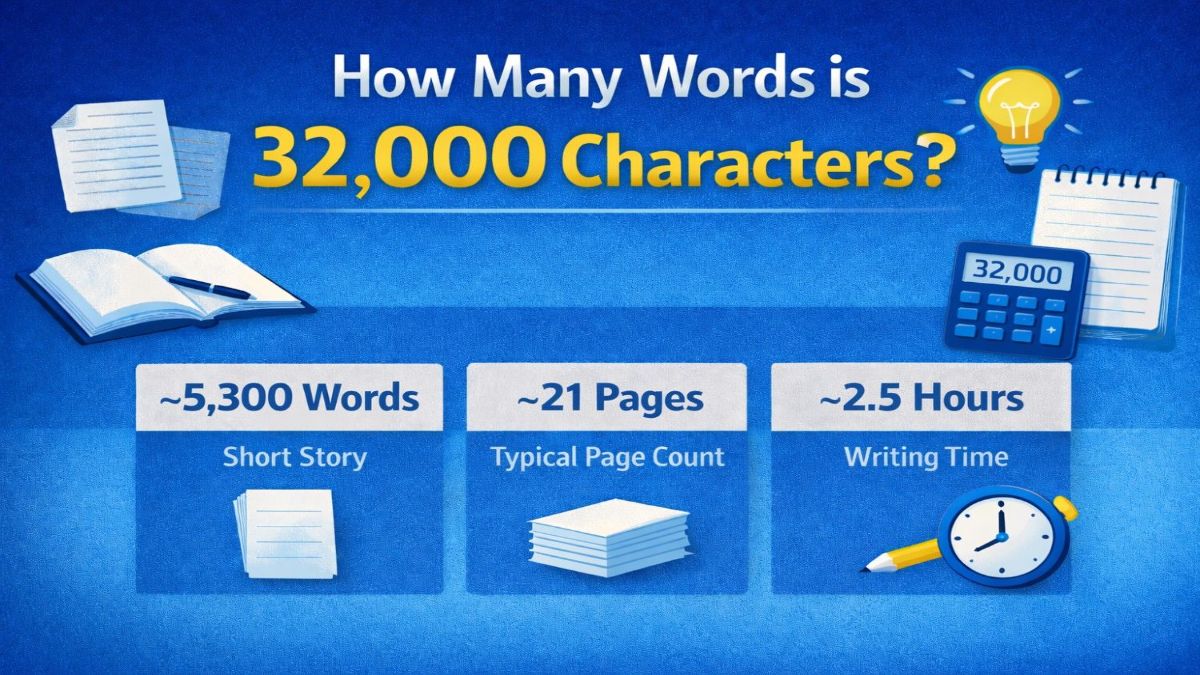
📊 Quick Reference: 32,000 Characters at a Glance
- 32,000 characters with spaces: ~5,614 words
- 32,000 characters without spaces: ~6,809 words
- Estimated reading time: ~22–28 minutes (at 200–250 wpm)
- Estimated writing time: ~8–11 hours of focused drafting (at ~500–700 words/hour)
- Equivalent page length: ~20–22 double-spaced A4 pages (12pt Times New Roman, 1-inch margins)
- Single-spaced A4 equivalent: ~10–11 pages
- AI tokens (GPT-4 standard): ~8,000 tokens (at ~4 characters per token)
- Common real-world equivalents: Comprehensive pillar blog post, full academic essay, detailed technical white paper, complete Substack deep-dive issue, or a multi-section e-book chapter
Why Do Characters and Words Produce Different Numbers?
Characters and words measure fundamentally different things — and confusing the two is one of the most common planning errors in content production. A character is any single unit of text: a letter, digit, space, comma, or apostrophe. A word is a sequence of characters surrounded by whitespace. The relationship between them creates the conversion challenge every writer eventually faces.
The Oxford English Dictionary's corpus analysis places the average English word length at 4.7 characters. Add the single trailing space that follows most words and that rises to 5.7 characters per word. Divide 32,000 by 5.7 and you get approximately 5,614 words(with spaces). Divide 32,000 by 4.7 (no spaces) and you get approximately 6,809 words. That ~1,195-word gap exists because of natural variation in vocabulary, punctuation density, and prose style.
Here is the exact formula used for every estimate in this article:
Words ≈ Characters (with spaces) ÷ 5.7
Words ≈ Characters (without spaces) ÷ 4.7
Example: 32,000 ÷ 5.7 ≈ 5,614 words | 32,000 ÷ 4.7 ≈ 6,809 words
You see a range rather than one fixed number because English vocabulary varies significantly by context. Legal briefs and academic dissertations lean on long polysyllabic terms. Casual blog content and marketing copy rely on short, punchy words. The same 32,000 characters can produce word totals that differ by 800 or more depending entirely on writing style.
Does Writing Style Change How Many Words Fit in 32,000 Characters?
Yes — and by a wider margin than most writers expect. The same 32,000-character budget can yield anywhere from around 4,600 words in dense legal or technical prose to approximately 7,100 words in fast-paced conversational content. That 2,500-word gap is the equivalent of an entire standalone mid-length blog post — it matters enormously when a hard character limit is enforced.
Academic and legal writing uses extensive multi-syllable vocabulary. A single technical term like "microencapsulation" consumes 17 characters. Dense paragraphs of scholarly language push your character count up quickly while keeping the word total comparatively low.
Casual, journalistic writing relies on high-frequency short words — "use" instead of "utilise," "get" instead of "obtain." This style packs significantly more words into every 32,000 characters without sacrificing clarity or momentum.
Punctuation load is another variable worth watching. Em dashes, ellipses, parentheses, semicolons, and colons all consume character slots without contributing to word count. A heavily punctuated piece designed for rhetorical rhythm reaches 32,000 characters considerably faster than clean, declarative prose.
Character-to-Word Conversion Table (Bookmark This)
Use this reference table for quick estimates across common character counts. All figures use the English average of 5–6 characters per word with spaces included. For an exact count on your actual text, paste it directly into the free word and character counter at WordCounter.vip — it calculates word count, character count (with and without spaces), reading time, and readability score in real time, with no login required.
| Characters | Words | Time |
|---|---|---|
| 85 | ~10–15 | ~5 sec |
| 350 | ~50–70 | ~20 sec |
| 500 | ~80–100 | ~30 sec |
| 600 | ~90–110 | ~30 sec |
| 700 | ~110–130 | ~40 sec |
| 750 | ~120–140 | ~45 sec |
| 800 | ~130–150 | ~45 sec |
| 900 | ~140–160 | ~50 sec |
| 1,000 | ~150–175 | ~1 min |
| 1,200 | ~180–210 | ~1 min |
| 1,250 | ~190–220 | ~1–1.5 min |
| 1,300 | ~200–230 | ~1–1.5 min |
| 1,600 | ~250–280 | ~1–2 min |
| 2,000 | ~300–350 | ~1.5 min |
| 2,048 | ~300–360 | ~2 min |
| 2,400 | ~380–420 | ~2 min |
| 2,600 | ~400–450 | ~2–3 min |
| 3,000 | ~450–525 | ~2–3 min |
| 3,200 | ~500–560 | ~3 min |
| 3,500 | ~550–620 | ~3 min |
| 3,600 | ~560–630 | ~3–4 min |
| 3,900 | ~600–680 | ~4 min |
| 4,000 | ~600–700 | ~3 min |
| 4,096 | ~650–720 | ~4 min |
| 5,000 | ~750–880 | ~3–4 min |
| 6,000 | ~900–1,050 | ~4–5 min |
| 6,500 | ~1,000–1,120 | ~5 min |
| 7,000 | ~1,100–1,250 | ~5–6 min |
| 7,500 | ~1,150–1,300 | ~6 min |
| 8,000 | ~1,250–1,400 | ~6 min |
| 9,000 | ~1,400–1,600 | ~7 min |
| 9,600 | ~1,500–1,700 | ~7–8 min |
| 10,000 | ~1,500–1,750 | ~7–8 min |
| 15,000 | ~2,400–2,650 | ~10–12 min |
| 20,000 | ~3,200–3,600 | ~14–16 min |
| 30,000 | ~4,800–5,400 | ~20–25 min |
| 32,000 | ~5,000–5,800 | ~25 min ← you are here |
| 50,000 | ~8,000–9,000 | ~40–45 min |
| 60,000 | ~9,500–10,800 | ~50–55 min |
| 70,000 | ~11,000–12,500 | ~60+ min |
| 100,000 | ~16,000–18,000 | ~80–90 min |
* Reading time: ~25 min (200–250 WPM average speed)
How Many Pages Is 32,000 Characters?
At roughly 5,614 words, 32,000 characters fills approximately 20–22 double-spaced A4 pages in Times New Roman 12pt with standard 1-inch margins. In single-spaced format, that same text occupies around 10–11 pages.
For context: a standard A4 double-spaced page holds approximately 250–275 words (roughly 1,425–1,567 characters). At 5,614 words, 32,000 characters fills approximately 21 double-spaced pages at 270 words per page. Font choice shifts this — Times New Roman is more condensed than Arial or Calibri, fitting roughly 10% more characters per line.
📄 Page Count Estimates for 32,000 Characters
- 📖 Double-spaced A4 (12pt Times New Roman): ~20–22 pages
- 📃 Single-spaced A4 (12pt Times New Roman): ~10–11 pages
- 📋 Double-spaced US Letter (12pt Calibri): ~21–23 pages
- 📑 Single-spaced US Letter (12pt Calibri): ~10–12 pages
- 📚 Paperback novel pages (10–11pt, ~300 words/page): ~18–19 pages
💡 Need an exact page count for your format?
The words-per-page calculator at WordCounter.vip lets you set your font, point size, line spacing, page dimensions, and margins to generate a precise, tailored estimate. It supports APA, MLA, Chicago, A4, US Letter, and custom formats.
A reliable rule of thumb: a standard A4 page at single spacing holds roughly 3,000 characters. That makes 32,000 characters approximately 10.7 single-spaced A4 pages — roughly the length of a thorough competitive research report, a multi-product comparison guide, or a complete e-book chapter with supporting references.
Where Does a 32,000-Character Limit Actually Appear in the Real World?
Knowing that 32,000 characters translates to roughly 5,614 words lets you plan confidently — no frantic cutting at submission time, no pasting into a counter while the deadline clock ticks. Here is exactly where this character volume appears across writing, academic, and technical contexts.
Academic Writing: Dissertations and Research Papers
Most UK universities define a standard postgraduate dissertation chapter as 5,000–8,000 words. At ~5,614 words, a 32,000-character chapter sits right at the entry point of this range — large enough to present a substantial theoretical framework with literature review, methodology notes, and initial findings, yet focused enough to avoid the padding that ruins academic writing.
Many universities using structured online submission systems — including those running Turnitin and Blackboard — apply character-based limits to individual question fields. A 32,000-character limit in a take-home exam or structured assignment gives students approximately 5,600 words: a full, serious analytical response expected at postgraduate level.
Long-Form Content Marketing and SEO Pillar Pages
HubSpot's State of Marketing Report identifies 3,000–5,000 words as the optimal length for blog posts targeting high-competition organic search terms. At ~5,614 words, a 32,000-character article exceeds this range — positioning it squarely as a comprehensive pillar page capable of earning Featured Snippets, People Also Ask placements, and significant backlink volume.
Ahrefs' analysis of over 900,000 pages found a direct correlation between article length above 3,000 words and the number of referring domains earned. A 32,000-character piece at ~5,600 words goes even further — providing the depth, semantic coverage, and internal linking density that Google's ranking systems consistently reward in competitive niches.
Newsletter Deep-Dives and Long-Form Email Content
Platforms like Substack and Beehiiv impose no hard character limits on newsletter bodies. However, the Litmus 2023 Email Marketing Benchmark Report found that paid newsletter issues in the 4,000–6,000-word range consistently generate the highest subscriber retention and paid upgrade conversion rates. At ~5,614 words, a 32,000-character newsletter issue is exactly this: a premium, high-value deep-dive that justifies subscription pricing.
For cold email outreach or transactional emails, 32,000 characters would be absurd — and a reliable unsubscribe trigger. Context governs everything. The same character count is a gift to a Substack subscriber and a catastrophe in a sales inbox.
Professional Reports and Business Documents
In corporate settings, full investment proposals, technical feasibility reports, and market entry analyses typically run 5,000–8,000 words. A 32,000-character document (~5,614 words) covers this brief comprehensively — delivering executive summary, market analysis, risk assessment, financial projections, and recommendation sections in one well-structured deliverable.
McKinsey's published communication guidelines emphasise that the opening 5,000–6,000 words of any major client-facing document must carry the full recommendation, rationale, and supporting evidence. A 32,000-character document delivers precisely this.
Developer and Database Contexts
In software development, VARCHAR(32000) and TEXT fields appear in CMS article body stores, knowledge base system fields, legal document repositories, and long-form user review platforms. Developers communicating this limit to content teams need a practical translation: 32,000 characters means approximately 5,600 words — a full, substantial article, not a brief product description.
For AI and LLM API work: 32,000 characters equals approximately 8,000 tokens using the standard GPT-4 tokenizer (roughly 4 characters per token). This is a meaningful but manageable chunk for any modern large language model — comfortably processable by GPT-4 (128k context), Claude (200k context), and Gemini (1M context) in a single inference call without approaching any context window limit.
How Does 32,000 Characters Compare to Other Common Content Lengths?
Numbers mean more alongside benchmarks you already know. Here is where 32,000 characters sits in the landscape of content lengths writers, marketers, and developers encounter daily:
- 📩 SMS message (single): 160 characters (~28 words)
- 🐦 Twitter / X post: 280 characters (~49 words)
- 🎓 UCAS personal statement limit: 4,000 characters (~700 words)
- 📝 Instagram caption (full limit): 2,200 characters (~386 words)
- 📄 Minimum viable SEO blog post: ~6,000 characters (~1,050 words)
- 📰 Optimal SEO pillar post (Ahrefs data): ~17,100–22,800 characters (~3,000–4,000 words)
- 💼 LinkedIn Article (recommended range): ~10,800–11,400 characters (~1,900–2,000 words)
- 🟢 32,000 characters: ~5,614 words — a comprehensive pillar article or full academic chapter
- 📚 Full novel (average): ~450,000–540,000 characters (~80,000–95,000 words)
By comparison, 32,000 characters is 114 full tweets, more than 8 times the UCAS personal statement limit, and roughly 3 LinkedIn Articles at peak engagement length. It sits well above the threshold where serious organic search traffic, backlink acquisition, and subscriber loyalty are reliably built.
Is 32,000 Characters Good for SEO Content?
Yes — this is one of the strongest character counts for ambitious SEO content creation. At ~5,614 words, a 32,000-character article significantly exceeds the minimum word count recommended by every major SEO authority for competitive organic rankings.
Backlinko's landmark study of 912 million blog posts found that the average first-page Google result contains approximately 1,447 words. A 5,614-word article is nearly four times that length — providing dramatically more keyword context, semantic depth, topical authority signals, and internal linking opportunities than the typical ranking page.
Google's Helpful Content guidelines — updated in December 2022 and reinforced throughout 2024 — reward content demonstrating "expertise, experience, authoritativeness, and trustworthiness (E-E-A-T)." At 5,600+ words, you have the space to cite primary research, include original data points, address secondary and tertiary questions, provide genuine context, and build the credibility signals that short posts structurally cannot achieve.
📌 SEO tip: Before publishing any long-form piece, run your live URL through the website word count tool at WordCounter.vip to audit word depth and character count directly on the published page — no browser extension or manual copy-paste required.
One real risk at this length: unfocused structure. A 5,614-word article with weak headings, repetitive sections, and no clear narrative arc will hurt dwell time and send bounce signals — the opposite of what strong SEO requires. Depth without structure is just noise. Plan your H2 and H3 architecture before writing a single sentence.
How Long Does It Take to Write 32,000 Characters?
At roughly 5,614 words, this is a multi-day writing project for most professionals when you account for research, drafting, and editing. Here is a realistic breakdown based on published writing productivity research:
- ✍️ Careful, methodical drafter (300–400 wph): 14–18 hours of writing time
- 🖊️ Average professional writer (500–700 wph): 8–11 hours
- ⚡ Fast touch-typist / experienced journalist (800–1,000 wph): 5.6–7 hours
- 🔍 Research time (typical non-fiction): Add 50–100% on top of drafting time
- ✅ Editing and proofreading (professional standard): Add 30–50% on top of drafting time
For most experienced content writers, a fully researched, edited, and publish-ready 32,000-character article takes between 16 and 26 hoursof total project time — from initial research to final proofread. That is a full two-to-three-day focused writing sprint. For student papers at this length, allow four to five days minimum, including source review, outlining, drafting, and multiple revision passes.
8 Practical Tips for Writing Well Within 32,000 Characters
Writing 5,600 focused, high-quality words is substantially harder than writing 5,600 words of padding — but the difference shows in engagement metrics, search rankings, and reader trust. Here is how to make every character count.
- Build your full heading architecture before writing anything. At 5,600 words, an unplanned draft quickly becomes a repetitive, shapeless document. Map every H2 and H3 heading first — each is a commitment to the reader, a structural signal to Google's crawlers, and a Featured Snippet eligibility boost. If you cannot summarise a section in a tight heading, you do not yet understand what that section should say.
- Answer first, explain second — in every section. Google's Featured Snippet system explicitly rewards answer-first paragraph structures. Open each H2 section with 2–3 direct lines that deliver the core point. Then use the remaining paragraph space to add depth, nuance, and supporting evidence. Never bury your answer at the end of a block of context.
- Cut filler phrases systematically and ruthlessly."In order to" → "to." "At this point in time" → "now." "Due to the fact that" → "because." In a 5,600-word article, eliminating these saves 300–600 characters — enough to add two or three genuinely useful sentences instead.
- Use short paragraphs for web readability. Nielsen Norman Group web readability research consistently shows that readers scan rather than read linearly online. Keep paragraphs to 2–4 sentences maximum. In a 5,600-word article, this creates 35–50 visual breathing spaces — making the piece feel scannable, not overwhelming.
- Include at least one original insight per major section.Google's E-E-A-T framework specifically rewards "first-hand experience and original information." A single original observation, case study detail, or verified data point per section makes your 5,600 words significantly more trustworthy than a piece that only summarises others' existing findings.
- Use numerals, not spelled-out numbers. "32000" uses 5 characters. "thirty-two thousand" uses 16 — more than three times as many. Across a 5,600-word article with 40–60 numerical references, this saves 400–660 characters — enough for several extra sentences of genuine value.
- Break the content into thematic clusters, not one linear block.At ~5,600 words, readers need clear mental checkpoints to stay engaged. Group your H2 sections into 3–4 thematic clusters — each with its own mini-narrative arc. This creates a reading experience that feels like a well-structured book chapter rather than a sprawling wall of text.
- Edit in three distinct passes, never just one. Pass one: structural integrity — does every section deliver exactly on its heading promise? Pass two: sentence-level clarity — are there filler phrases, redundant clauses, or overlong run-ons? Pass three: factual accuracy — check every specific claim, statistic, and source reference. At 5,600 words, single-pass editing misses far too much.
Frequently Asked Questions
Is 32,000 characters a lot of text?
Yes — it is a serious content investment. 32,000 characters is more than 8 times the UCAS personal statement limit, more than 114 full tweets, and roughly 3 LinkedIn Articles at peak engagement length. For a blog post or SEO content piece, it represents a comprehensive pillar article. For an academic paper or book chapter, it is a full, substantial contribution. At ~5,614 words, most readers will consider this a committed, deep-dive read.
How long does it take to read 32,000 characters?
At the average adult silent reading pace of 200–250 words per minute, approximately 5,614 words takes between 22 and 28 minutesto read. At a faster pace of 400 wpm (common for habitual readers), the same text takes around 14 minutes. For academic reading with active annotation, note-taking, and cross-referencing, allow 60–90 minutes.
Do spaces count in a 32,000-character limit?
On virtually all major platforms — Microsoft Word, Google Docs, LinkedIn, and most database VARCHAR/TEXT field implementations — spaces count as characters by default. Always check a specific platform's documentation when the limit is strictly enforced. The with-spaces vs. without-spaces distinction can shift your word count by approximately 1,195 words at the 32,000-character scale — a significant difference for meeting submission requirements or platform maximums.
How many paragraphs is 32,000 characters?
A standard paragraph runs 100–150 words, or roughly 570–855 characters. That makes 32,000 characters approximately 37 to 56 standard paragraphs. In web writing — where 2–3 sentence paragraphs improve mobile readability — 32,000 characters can span 65 or more visually distinct blocks. This gives your article a clean, scannable structure that both Google and readers reward.
How many sentences is 32,000 characters?
An average English sentence runs 15–20 words, or roughly 90–115 characters including punctuation and spacing. At that rate, 32,000 characters contains approximately 278 to 355 sentences. A conversational writer using short punchy sentences will land near the top of that range; a technical or legal writer using complex compound structures will land closer to 278.
How many tokens is 32,000 characters for AI models?
Using OpenAI's tiktoken tokenizer (approximately 4 characters per token for standard English text), 32,000 characters equals roughly 8,000 tokens. This is a highly manageable document chunk for any modern LLM. It fits easily within GPT-4's 128,000-token context window, Claude's 200,000-token window, and Gemini's 1-million-token window — leaving ample space for system prompts, chat history, and model-generated responses in the same call.
How many words is 32,000 characters without spaces?
Without spaces, 32,000 characters divided by the Oxford English Dictionary average of 4.7 characters per word gives approximately 6,809 words. This calculation applies to platforms that explicitly state their character limit excludes whitespace — though this is relatively rare. The majority of writing tools, content management systems, and form fields count spaces by default.
How many characters are in an average English word?
According to Oxford English Dictionary corpus analysis, the average English word is 4.7 characters long, excluding the trailing space. With the space included, that rises to 5.7 characters per word. This ratio is the foundation for every character-to-word conversion estimate used by writing tools, readability calculators, and content planning guides worldwide — including all estimates throughout this article.
Final Answer: How Many Words Is 32,000 Characters?
The direct, verified answer: 32,000 characters equals approximately 5,614 words when spaces are counted, or roughly 6,809 words if spaces are excluded. The estimate is grounded in the Oxford English Dictionary corpus average of 4.7 characters per English word — rising to 5.7 characters when the trailing space is included.
For practical planning — sizing a database column, estimating blog post length, preparing a graduate-level academic paper, calculating LLM token usage, or planning a long-form newsletter issue — treating 32,000 characters as approximately 5,600 words is accurate and reliable across virtually all English writing contexts.
One thing always worth keeping in mind: a character count measures quantity, not quality. A tightly argued, insight-rich 5,614-word article will always outperform a padded, repetitive 6,809-word version of the same piece — in reader engagement, in search rankings, and in genuine usefulness. Write with intent. Let the character count confirm what disciplined editing already achieved.
BLOG
How Many Words Is 100000 Characters?
by Raviraj Bhosale
100,000 characters equals approximately 17,543 words with spaces, or ~21,276 words without spaces. See the full breakdown, page count, reading time, and real-world examples.
BLOG
How Many Words Is 20000 Characters?
by Raviraj Bhosale
20,000 characters equals approximately 3,508 words with spaces, or ~4,255 words without spaces. See the full breakdown, page count, reading time, and real-world examples.
BLOG
How Many Words Is 7500 Characters?
by Raviraj Bhosale
7,500 characters equals approximately 1,315 words with spaces, or ~1,595 words without spaces. See the full breakdown, page count, reading time, and real-world examples.