Ideal Blog Post Length for SEO in 2026
By Raviraj Bhosale · Updated May 21, 2026 · 9 min read
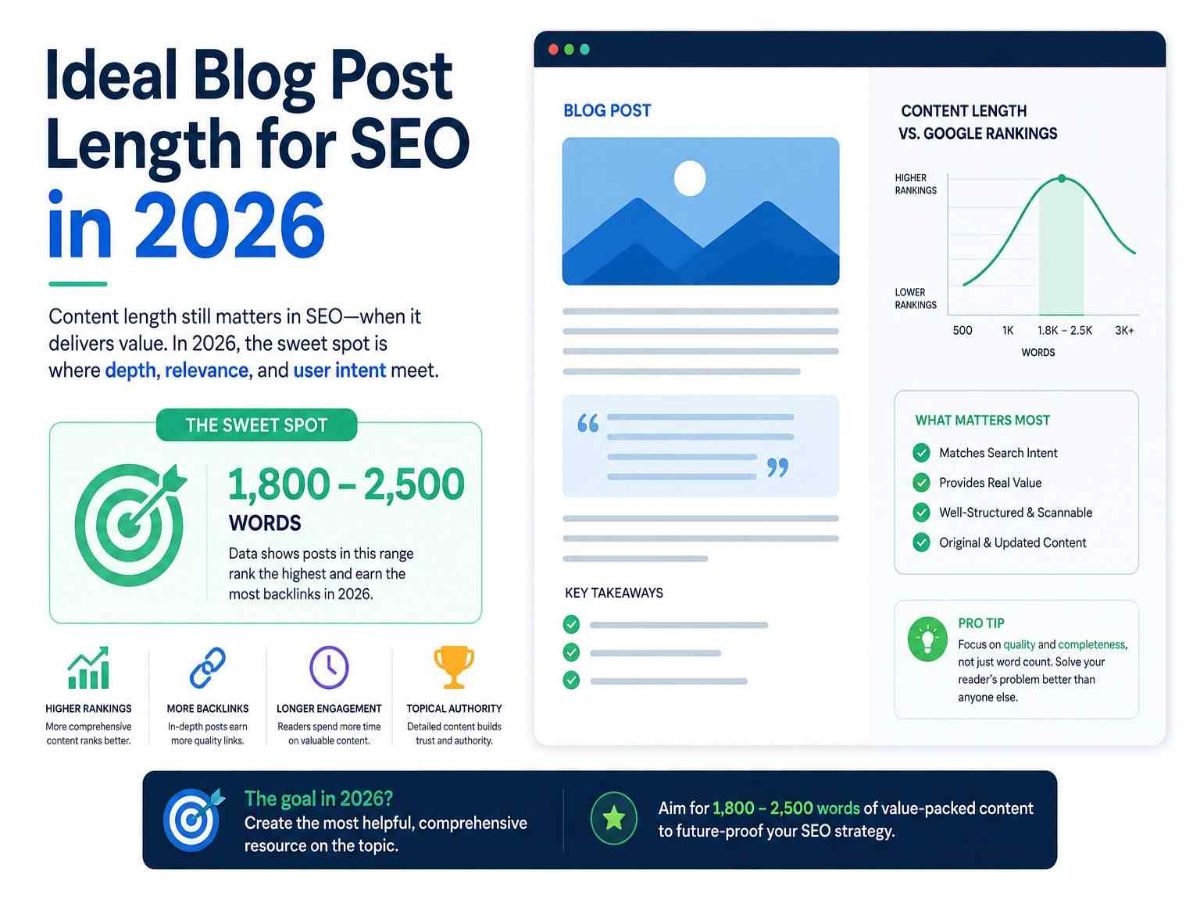
The ideal blog post length for SEO in 2026 is 1,500 to 2,500 words for most topics. Long-form content between 2,000 and 3,000 words consistently ranks better for competitive keywords. But word count alone does not guarantee rankings — quality, depth, and relevance matter far more than hitting a number.
If you have been chasing a magic word count hoping Google rewards you just for length, you are thinking about this the wrong way. Google does not count your words. It measures how well you answer the reader's question. That said, longer content usually covers more ground — and covering more ground tends to earn more rankings.
📝 Quick Reference: Ideal Blog Length by Content Type (2026)
- General informational posts: 1,500 – 2,000 words
- Competitive SEO articles: 2,000 – 3,000 words
- How-to guides and tutorials: 1,700 – 2,500 words
- Listicles and roundups: 1,200 – 2,000 words
- Product reviews and comparisons: 1,500 – 2,500 words
- News and trending topics: 600 – 1,000 words
- Pillar pages and topic clusters: 3,000 – 5,000+ words
Does Blog Post Length Actually Affect SEO Rankings?
Yes — but not in the way most people assume. Word count is not a direct ranking factor. Google has confirmed this multiple times through its Search Central documentation and public statements from its Search Liaison team. What long-form content does is create more opportunities to rank — more keywords, more subtopics, more chances to match search intent.
A 2023 study by Backlinko analyzing 11.8 million Google search results found that the average first-page result contains 1,447 words. That is the real-world benchmark from actual ranking pages — not a content marketing myth.
SEMrush content research found that articles exceeding 3,000 words receive 3 times more traffic, earn 4 times more shares, and attract 3.5 times more backlinks than shorter pieces. Those are not word count rewards — they are the natural result of content that covers a topic more completely than anything else out there.
What Is the Ideal Blog Post Length for SEO in 2026?
For most competitive topics, 1,800 to 2,500 words is the current sweet spot. This range is long enough to cover a topic with real depth, rank for multiple related keywords, and satisfy reader intent — without padding content just to hit a number.
HubSpot's annual State of Marketing report has consistently shown that blog posts between 2,100 and 2,400 words generate the most organic traffic across industries. This benchmark has held for three consecutive years, which makes it a reliable data point rather than a one-off finding.
The key shift in 2026 is Google's increased emphasis on Helpful Contentand E-E-A-T (Experience, Expertise, Authoritativeness, Trustworthiness). A 3,000-word article filled with fluff now performs worse than a sharp, well-researched 1,800-word article written by someone who clearly knows the subject.
How Has Google's Helpful Content Update Changed the Rules?
Google's Helpful Content System — rolled out starting in 2022 and significantly expanded through 2023 and 2024 — directly targets content written primarily to rank rather than to help. This is one of the most important algorithm shifts in the last decade for content creators.
According to Google's official Search Central documentation, helpful content is defined as content that provides a satisfying experience for the reader, comes from a knowledgeable source, and covers the topic in a way that leaves the user with what they came for.
What this means practically: writing 4,000 words because a competitor has 4,000 words is a losing strategy. Writing 2,000 words that actually answer every reasonable question a reader might have — with real examples, accurate data, and clear structure — is what performs in 2026.
What Is the Right Blog Length for Different Content Types?
Not all content serves the same purpose, and one-size-fits-all length advice is one of the most common mistakes in content strategy. Here is a realistic breakdown of what works by content format, based on industry research and ranking data.
📌 Blog Length by Content Type — 2026 Benchmarks
- How-to guides and tutorials (1,700 – 2,500 words): Readers want step-by-step clarity. Too short and you skip important steps. Too long and people abandon before finishing. The middle range covers the process without losing the reader.
- Listicles and roundups (1,200 – 2,000 words): Each list item needs enough context to be useful. Thin one-liners do not rank. Meaty, explained items do.
- Product reviews and comparisons (1,500 – 2,500 words): Users making purchase decisions want thorough information. Short reviews feel untrustworthy.
- Opinion and thought leadership (800 – 1,500 words): Quality of the argument matters more than length. A sharp 1,000-word take outperforms a padded 2,500-word one.
- News and trending content (600 – 1,000 words): Speed and accuracy matter here. Readers want the facts fast. Bloated news posts lose engagement quickly.
- Pillar pages (3,000 – 5,000+ words): These are comprehensive topic hubs designed to rank for broad keywords and link to related cluster content. Shorter pillar pages consistently underperform.
Does Longer Content Always Rank Higher?
No — and this is worth saying clearly. Length without quality is dead weight.Ahrefs conducted a large-scale study of ranking content and found no consistent correlation between word count and position for short-tail or navigational queries. For informational and commercial queries, however, longer content did show a measurable advantage.
The distinction matters. If someone searches "best laptop 2026," they expect a detailed, comparative answer — and longer content delivers that. If someone searches "gmail login," they want one sentence and a link. Giving them 2,000 words is not helpful — it is annoying.
Match your content length to your reader's intent. That single principle outperforms every arbitrary word count target ever published in a content marketing blog.
How Does AI-Generated Content Affect Ideal Blog Length in 2026?
The rise of AI-generated content has flooded the web with long, surface-level articles written at scale. Google's response has been to increase the weight of experience signals and originality markers in its ranking systems. This is exactly why E-E-A-T now includes "Experience" as the first E — it was added specifically to reward content from people with firsthand knowledge.
In 2026, the winning content strategy is not "write more words." It is "write things only you can write." Original research, personal case studies, first-hand testing, and expert analysis are the differentiators that AI-generated content cannot easily replicate.
A 1,500-word article built on original data or genuine expertise now outranks a 3,000-word generic article on the same topic in most competitive niches. This shift rewards real content creators and punishes content factories.
What Does Readability Have to Do with Blog Post Length?
Everything. A 2,500-word article that is dense, poorly structured, and written in academic English will have a terrible bounce rate — and Google tracks that through engagement signals. A 2,500-word article broken into clear sections, short paragraphs, and scannable subheadings keeps readers on the page.
Nielsen Norman Group research shows that users read only 20 to 28 percentof the words on an average web page. They scan first. If your headings, bullet points, and first sentences do not immediately signal relevance, readers leave. And when they leave, rankings fall.
The practical takeaway: structure your long-form content so that a scanner can understand the article's value within 10 seconds. Then write the full depth for readers who stay. Both groups should feel the content was worth their time.
How Should You Decide Blog Length for Your Niche?
The most reliable method is competitor analysis — but done correctly. Search your target keyword on Google and check the word count of the top five ranking pages. Do not just match their average — aim to be 10 to 20 percent more comprehensivewhile cutting any filler they have.
✅ 5-Step Framework for Choosing Blog Post Length
- Step 1 — Identify search intent: Is the query informational, commercial, or navigational? Match your length to the intent type.
- Step 2 — Audit top-ranking competitors: Check the average word count of pages ranking in positions 1 to 5 for your target keyword.
- Step 3 — Map your topic depth: List every subtopic, question, and example the reader genuinely needs. That list tells you your natural length.
- Step 4 — Write to cover, not to fill: Cover every subtopic properly. Do not pad sections just to hit a word count. Readers notice, and so does Google.
- Step 5 — Review and trim: After writing, cut anything that does not add clear value. Tighter writing almost always performs better than bloated writing.
What Are the Key SEO Content Signals Beyond Word Count?
Word count is one signal among many. In 2026, Google's ranking systems consider a much wider picture when evaluating content quality. Understanding these signals helps you write content that ranks for reasons that actually hold up over time.
🔍 What Google Actually Evaluates (Beyond Length)
- Topical depth: Does the article cover the topic fully, including related subtopics and common questions?
- E-E-A-T signals: Is there a clear author? Is the source credible? Does the content reflect genuine expertise?
- Engagement and dwell time: Do readers stay and scroll, or bounce immediately?
- Backlink quality: Do authoritative sites link to this content as a reference?
- Content freshness: Is the information current? Outdated facts hurt rankings in fast-moving niches.
- Structured data: Schema markup (FAQ, HowTo, Article) helps Google understand and feature content in rich results.
- Internal linking: Does the article connect logically to related content on the same site?
Frequently Asked Questions
Is 500 words enough for a blog post to rank on Google?
For highly specific, low-competition queries — yes. For most competitive keywords, 500 words is too thin to rank consistently. It may rank initially but rarely holds a top position against longer, more thorough content covering the same topic.
How long should a blog post be for Google Discover?
Google Discover favors visually engaging, high-quality content with compelling titles and strong imagery. Length is less critical here — content between 800 and 1,500 wordsperforms well on Discover. What matters more is the quality of the headline, the featured image, and how well the content delivers on the title's promise.
Does blog post length affect AI search engines like Perplexity or Google AI Overviews?
AI search systems pull from content that is factually accurate, clearly structured, and well-attributed. Longer content with clear headings, cited sources, and concise section answers is more likely to be surfaced in AI-generated summaries. Writing in a direct, answer-first format increases visibility in AI Overviews significantly.
How often should I update old blog posts?
Content in fast-moving niches — technology, finance, health, SEO — should be reviewed every 6 to 12 months. Evergreen content can go longer without major updates, but checking for outdated statistics, broken links, and missing subtopics annually is good practice. Updated content often sees a rankings boost within weeks of republication.
Can a short blog post outrank a long one?
Absolutely — if it better matches search intent. A clean, accurate 800-word article that directly answers a specific question often outranks a padded 3,000-word piece that buries the answer in filler. Google's systems are increasingly good at identifying and rewarding content that gets the reader what they came for, fast.
Key Takeaways
- The ideal blog post length for SEO in 2026 is 1,500 to 2,500 words for most topics
- Backlinko data shows the average first-page Google result has 1,447 words
- HubSpot research identifies 2,100 to 2,400 words as the top-performing range for organic traffic
- Google's Helpful Content System rewards depth and genuine expertise — not raw word count
- Match content length to search intent: news articles need 600 words, pillar pages need 3,000+
- AI search engines (Google AI Overviews, Perplexity) favour clearly structured, well-cited, answer-first content
- Use a reliable word counter tool to track your article length as you write and avoid under- or over-shooting your target
Conclusion
The ideal blog post length for SEO in 2026 is the length it takes to cover your topic completely, match the reader's intent, and deliver more value than every competing page on the same subject. For most topics, that falls between 1,500 and 2,500 words. For pillar content and highly competitive keywords, you will likely need 3,000 or more.
Stop chasing a number. Start with the reader's question, cover it fully and honestly, structure it so it is easy to scan, and make sure every section earns its place. That approach will outperform any word count target in the long run.
If you want to track your writing length in real time, our free word counter tool shows your word count, character count, reading time, and readability score as you type — no sign-up needed.
Write for the reader first. Google will follow.
BLOG
How Many Words Per Page
by Raviraj Bhosale
Discover how many words fit on a page. Learn word counts for double spaced, single spaced, and handwritten pages with real examples.
BLOG
Best Resume Word Count For It Jobs In 2026
by Raviraj Bhosale
Find the ideal resume word count for IT jobs in 2026. Learn how many words your resume should have based on experience level, ATS scoring, and what hiring managers actually read.
BLOG
How Many Words Fit on an A4 Page
by Raviraj Bhosale
A document using Times New Roman 12pt font with standard spacing typically contains approximately 450 to 500 words per page. Learn how font, spacing, and margins all change the count.